Seventeen years of building other people's boards
FLASHPOINT PCBA has assembled boards for other people's products since 2009 and has never sold a product of its own. That single decision shapes everything else here: our engineering time belongs to your programme, our process data belongs to your audit trail, and our name never appears on the box.
- Founded
- 2009
- Staff
- 210
- Plants
- 2
- Active programmes
- 130
How the company started, and what it refused to become
The first programme was a controller assembly for an industrial instrumentation OEM that had been let down by a supplier who quoted fast and delivered late. It was one SMT line, a bench for through-hole work, and a promise that the DFM findings would arrive before the purchase order rather than after the first article.
That promise is the whole business model. The company deliberately stayed out of three things that contract manufacturers usually drift into: designing its own products, fabricating bare boards, and publishing a customer logo wall. Saying no to the first two keeps the engineering group honest about the processes it actually controls. Saying no to the third is a consequence of NDA being the default across 400 programmes since 2009.
The first quality system assessment was to ISO 9001:2015, and it is still the backbone of the system. What has been added since is depth rather than breadth: ISO 13485:2016 for medical devices, IATF 16949:2016 for automotive, AS9100D for aerospace and ITAR registration for defense work. Each one arrived because a customer needed it, not because a slide deck did.
Seventeen years later the work is the same shape as it was on day one — a customer sends a BOM and a Gerber set, an engineer tells them what will and will not build, and the answer arrives before the tooling is cut.
What we are good at, and what we are not
Three limits, written down because discovering them during your programme is expensive.
We assemble. We do not fabricate.
Bare-board fabrication is a different chemistry with different process control, and we do not own it. You ship boards from your fabricator or we work to your fab drawing with theirs. What we do control is what happens to the board after it arrives: print, placement, reflow, through-hole, test and box build under one quality system.
We review layout. We do not design it.
Our DFM engineers check land patterns against IPC-7351B, panelisation, thermal relief, mask webs and test-point access. They do not do schematic capture or original layout. If your team is short of layout capacity, we will tell you which parts of the design are most likely to fail at first article and let your engineer fix them.
Consumers are not our customer.
We build for engineers who own a specification: medical, aerospace and defense, automotive and EV, industrial automation, energy storage. A programme with no drawing, no revision control and no acceptance criteria is not a programme we can quote against. That rules out consumer novelty work, and it keeps the 6 lines available for buyers who need IPC-A-610 Class 2 or Class 3 evidence.
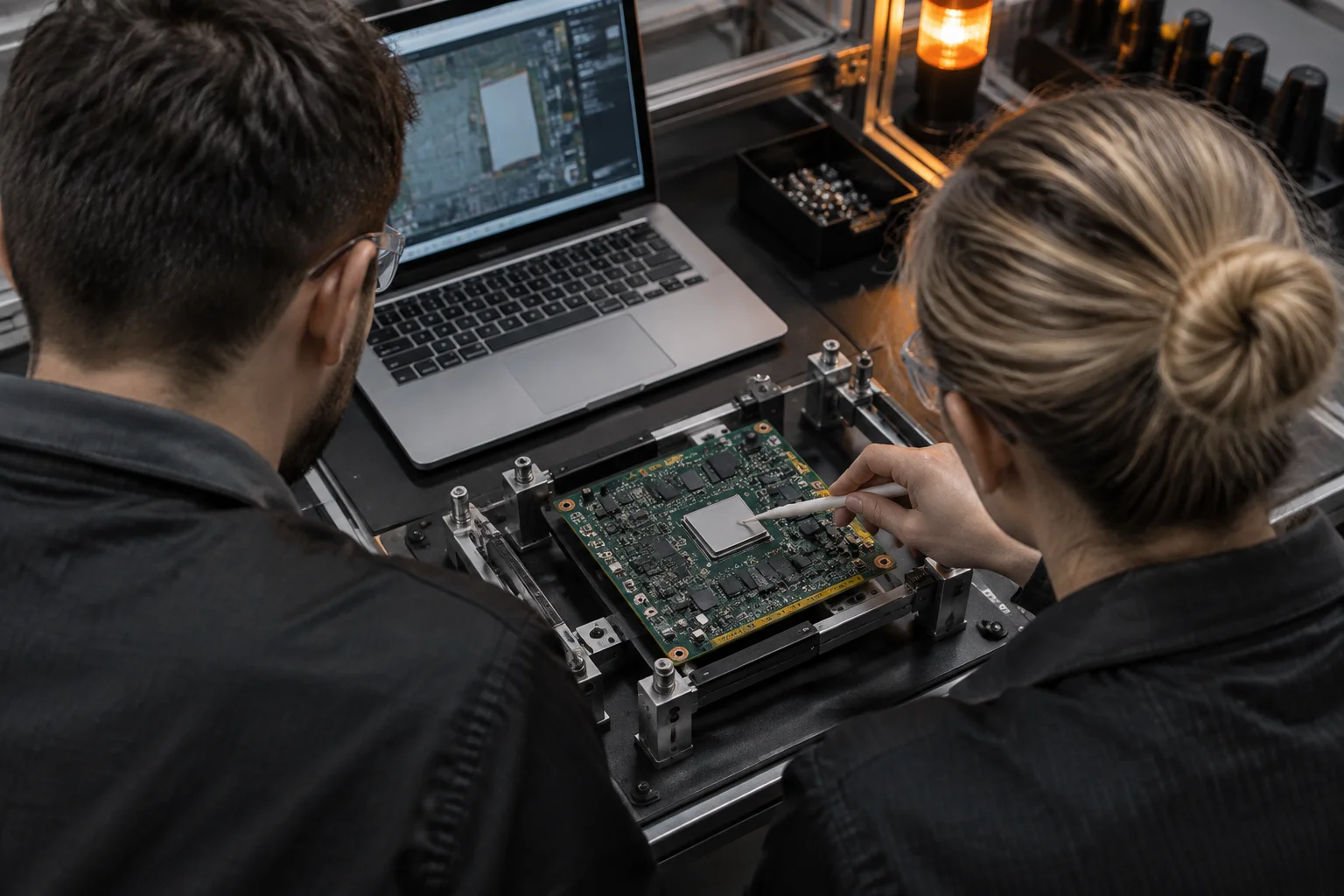
Engineering and production on one floor
Four roles carry a programme, and all four sit within sight of the lines they commit to. Nothing is specified by someone who has never run the process.
- DFM reviewer — reads your Gerber set and BOM against real machine limits, writes every finding as a change with a cost or schedule effect, and owns the 24 hour DFM report.
- NPI engineer — owns the first article: stencil and profile, AOI and SPI programmes, the FAI report with X-ray and cross-section data, and the golden sample that goes on the shelf.
- Process engineer — owns the line: print and SPI limits at CpK 1.67, 12-zone nitrogen reflow at ±1.5 °C repeatability, selective solder, cleaning and coating, and the response when a gate trips.
- Quality engineer — owns the records: calibration, non-conformance and corrective action, material certificates, ESD control to ANSI/ESD S20.20-2021, and the audit you may book at any time.
Because the four are on one floor, an escalation does not need a meeting. A process engineer can stop a line and walk a board to the bench where the DFM reviewer who approved it is sitting, which is usually how a marginal design gets fixed before it becomes a yield number.
Capability added, in the order it was added
We publish the two dated milestones and describe the rest by capability rather than by a marketing calendar.
-
2009
One line, one promise
The company opens in San Jose with a single SMT line, a through-hole bench and Class 2 workmanship to IPC-A-610. The first customer type is the one that stayed: an industrial OEM with a drawing, a revision and a date.
-
2009 – 2019
Depth before breadth
San Jose grows to 4 SMT lines — 3 volume and one flex line for NPI — in 42,000 sq ft (3,900 m²), with a 12,000 sq ft ESD-controlled store holding 4,000 part numbers and 150 people on site. X-ray, AOI and ionic contamination testing arrive as process control rather than as selling points.
-
2019
The Penang plant opens
A second site in the Bayan Lepas Free Industrial Zone adds 18,000 sq ft (1,670 m²), 2 SMT lines and 60 people under the same quality system. Its job is repeat production and high-mix kitting, which frees the San Jose flex line for prototypes and first articles.
-
Today
Six lines, one quality system
6 SMT lines, 210 staff, 130 active customer programmes and 38 in NPI at any time. Placement runs at 30,000 components per hour per line and 14 million placements a month across the group, up to 45,000 board assemblies a month.
-
Today
The system around the lines
ISO 9001:2015, ISO 13485:2016, IATF 16949:2016, AS9100D, ISO 14001:2015 and ITAR registration, with RoHS 2011/65/EU and REACH declarations per build. Tooling, fixtures and programming transfer to the customer after first article.
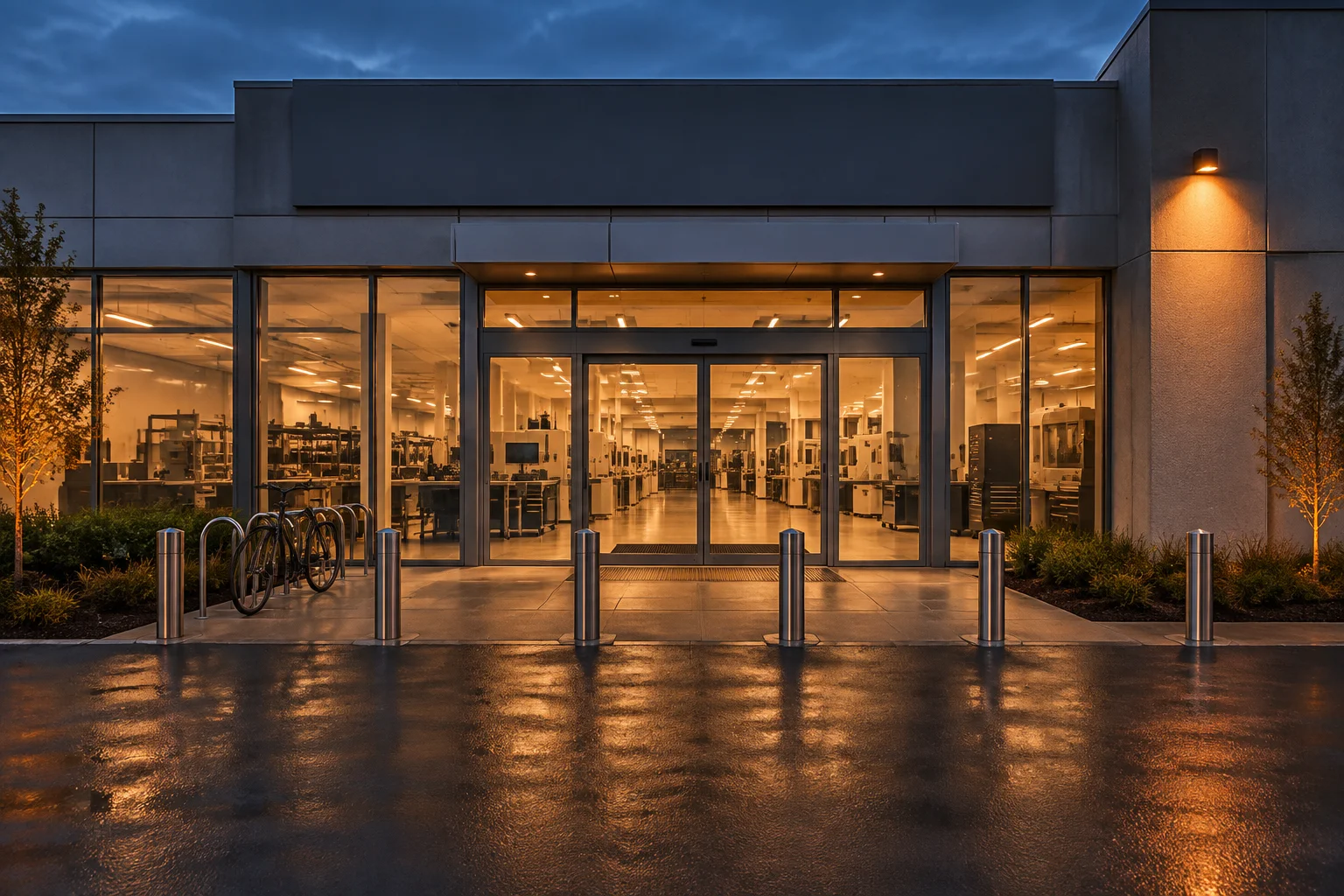
The two buildings, and what each one is for
San Jose makes the first board. Penang makes the ten-thousandth. Both run the same process controls, which is what makes a transfer between them boring.
The San Jose building on Zanker Road holds headquarters, the DFM and NPI engineering group, 4 SMT lines and the test and box build cells. First articles are built here, and every programme that needs ITAR handling stays here: ITAR-controlled technical data is handled only by US persons and is never copied to Penang.
The Penang plant in the Bayan Lepas Free Industrial Zone handles repeat production and high-mix kitting on 2 lines with 60 people, and it is the site that gives European and Asian customers a same-day engineering answer in their own working hours. Material planning is shared across the two sites, so a shortage in one becomes a transfer decision rather than a surprise.
People, training and certification
210 people work here: 150 in San Jose and 60 in Penang. Most of the floor is operator and technician work, and every operator who touches a board is certified to the workmanship class of the programme they run.
Certification is not a one-off induction. Operators are assessed against IPC-A-610 for the class they work to, and anyone doing rework is assessed separately against IPC-7711/7721 because repair criteria are stricter than assembly criteria. Hand soldering, selective solder and conformal coating each carry their own sign-off, and an operator whose certificate lapses comes off the line until reassessment rather than working under supervision. Training records sit in the same MES file as the serial numbers that operator built.
New operators enter through an apprenticeship route that pairs them with a line technician for their first production releases, and the inspection gates back them up: 3D SPI on 100 % of boards, 3D AOI after reflow and X-ray on every BGA. The gate catches what a new pair of hands misses, which is why we can grow the floor without growing the defect rate.
Governance and ethics
Four policies that customers audit most often, and what each one obliges us to do.
- Conflict minerals — OECD due diligence with support for SEC 13p-1 reporting; we publish what suppliers actually return, including non-answers.
- Anti-counterfeit — authorised distribution first, AS6081-style inspection for any open-market exception, and written customer approval before such a part is used.
- Confidentiality — mutual NDA by default; no customer name, logo or programme detail is published without written consent.
- Supplier code — labour, safety and environmental expectations written into the terms of every approved supplier, with ISO 14001:2015 obligations flowed down.
Environmentally, the San Jose and Penang plants run to ISO 14001:2015 with solder dross, flux waste, cleaning water and electronic scrap routed through licensed recyclers, and alloy chemistry verified by weekly pot analysis rather than by assumption.
The numbers behind the work
- San Jose floor space
- 42,000 sq ft (3,900 m²)
- Penang floor space
- 18,000 sq ft (1,670 m²)
- Placement rate
- 30,000 pcs per hour per line
- Customers since 2009
- 400 programmes, no published names
- Manufacturing records
- 10 years, IPC-1782 style
- Quote and RFQ data
- 24 months
Questions about the company
The company is privately held and independent, which matters more than it sounds: there is no parent group steering work to a captive plant, and no product line competing with yours for capacity. Decisions about adding a line, a certification or a plant are made against the 130 active programmes in the building, not against a quarterly target from somewhere else. That is also why we can say no to work that does not fit the process.
Usually yes, and the honest answer depends on when. The 4 lines in San Jose run 3 volume shifts and one flex line for NPI, and 38 programmes are in NPI at any time, so a prototype slot can typically be found inside a week. A new volume programme is planned against line changeover cost, not against wishful thinking: we will tell you the first month we can hold 45,000 units a month rather than promise it for the month you asked for.
Yes, and it is worth doing. A visit covers the print and SPI cell, the NPI line, reflow, AOI and X-ray, the test bay and the store where your material would sit, with the engineer who would own your programme walking it with you. Tell us the date and the scope and we confirm within one working day. ITAR areas are visited by US persons only, and phones stay outside that boundary.
Seventeen years, and the first conversation is still about your board.
Tell us what you are building. A process engineer will tell you what the process can and cannot hold — in writing, with numbers.