From 5 prototypes to 45,000 units a month — without changing supplier
The usual reason a program changes EMS partner is that the prototype house cannot scale and the volume house does not want the engineering work. We run both ends on one line set: the same process of record, the same stencil rules, the same acceptance criteria — from a 5-board engineering build to a 45,000-unit month, with no re-qualification when the volume changes.
- Prototype MOQ
- 5 boards
- DFM review
- 24 hours
- NPI pilot run
- 15 working days
- Production repeat order
- 3–4 weeks ARO
The four volume stages, run on one process of record
Scaling is not a change of process here, it is a change of tooling and cadence. The stencil thickness rules, the reflow profile family, the IPC-A-610 class and the traceability record stay identical. What changes at each stage is the fixture investment, the inspection sampling and the number of operators touching the product.
The reason this matters commercially: a program that re-qualifies at every stage pays for first articles, test fixtures and pilot builds two or three times over. A program that scales inside one process of record pays once. We show which tooling is prototype-only and which carries forward at quote stage, so the customer can see what is sunk cost and what is not.
-
5–50 boards · 5–8 working days
Engineering samples
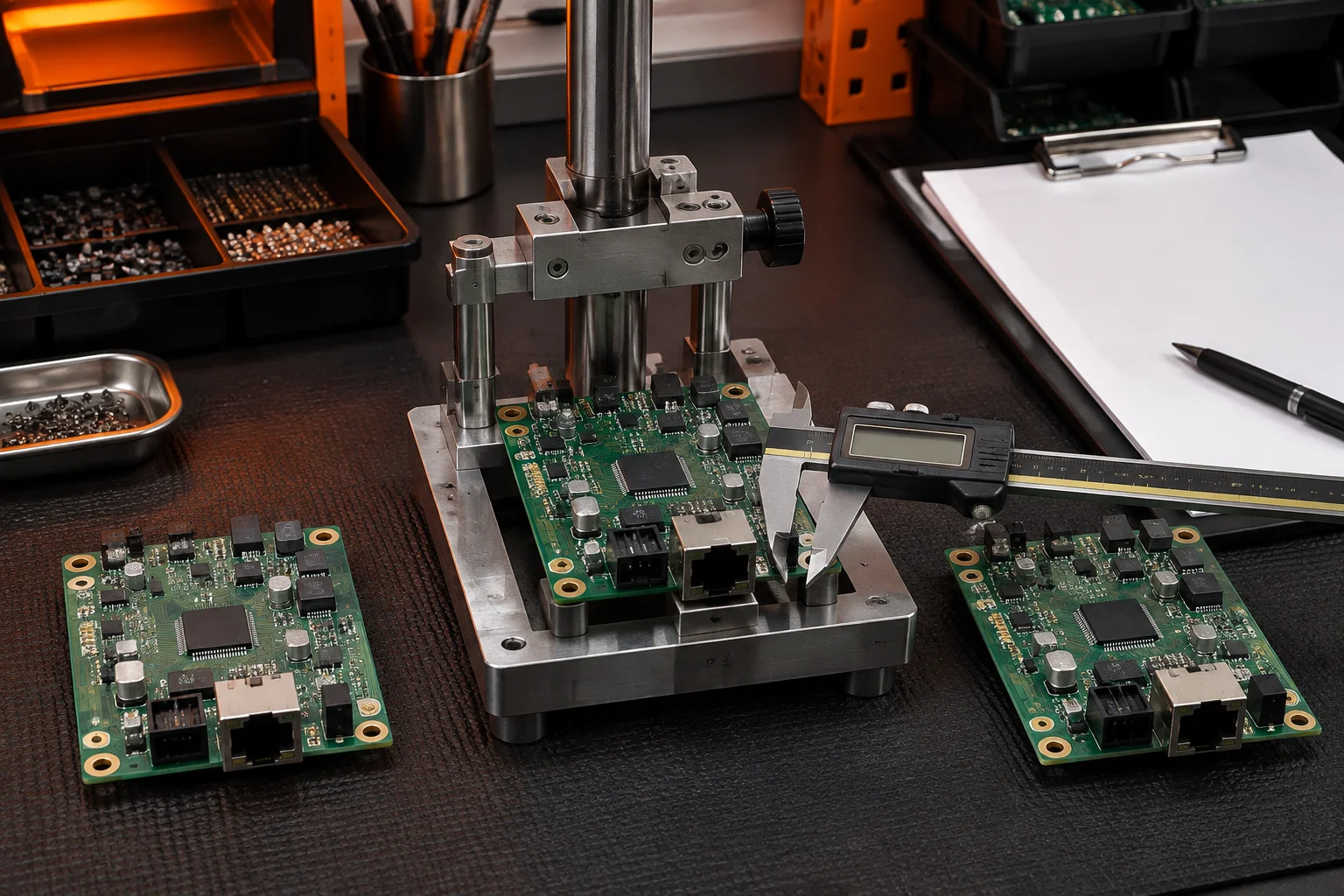
Run on the NPI and flex line in San Jose. Stencil cut in 4 hours, paste Type 4 or 5 depending on pitch floor, 3D SPI and inline AOI on every board, X-ray on all area arrays, and a full first-article inspection report with a micro-section through the finest-pitch device. Odd-form and through-hole parts are hand-soldered by certified operators, and no production fixture is bought yet. DFM feedback from this build goes back to the customer before the pilot run is quoted.
-
50–500 boards · 15 working days after DFM sign-off
Pilot run
Production-intent tooling: selective solder pallet or pin-in-paste stencil, a functional test fixture, and programming loaded on the target line. The control plan is written at this stage and the operator work instructions are validated against real hardware. A golden sample is retained, the FAI report is re-issued against the production tooling, and any deviation between sample and pilot build is dispositioned in writing before the pilot ships.
-
500–5,000 boards · 4–5 weeks ARO turnkey
Ramp
The program moves to a volume line with the panel tooling it will use in production. SPC is switched on for print volume and reflow profile, capacity is reserved against the forecast, and critical components get a second qualified source. If the program is automotive or medical, the PPAP-style or device-history documentation is built from the same MES data that the line is already recording — nothing is reconstructed afterwards.
-
5,000+ boards per month · 3–4 weeks ARO repeat
Volume production
Line-balanced across the six SMT lines with output up to 45,000 assemblies a month. Kitting runs from a 12,000 sq ft ESD store with 4,000 part numbers on the shelf, consignment or turnkey. Cost-down reviews run after the first production lots, and records are retained for 10 years per board serial number. A program can also be split across San Jose and Penang at this stage for regional supply or cost.
Lead time by stage, and what actually triggers it
Quoted dates are driven by three things: the DFM sign-off date, whether parts are turnkey or consigned, and whether any line item is on a long lead. The table shows the standard clock.
| Stage | Quantity | Lead time | Trigger or blocker |
|---|---|---|---|
| DFM review | Any | 24 hours | BOM and Gerber set received |
| Firm turnkey quote | Any | 48 hours | After DFM questions are closed |
| Engineering samples | 5–50 boards | 5–8 working days | All parts in stock |
| Samples with consigned or long-lead parts | 5–50 boards | 8–12 working days | Part arrival, not our line |
| NPI pilot run | 50–500 boards | 15 working days | DFM sign-off plus kitting complete |
| Turnkey ramp | 500–5,000 boards | 4–5 weeks ARO | Full kitting and fixture build |
| Production repeat order | 5,000+ per month | 3–4 weeks ARO | Existing program, no MOQ |
| Stencil fabrication | Per design | 4 hours | Released Gerber, nano-coated foil |
Long-lead parts are the single largest cause of a slipped prototype date, and they are visible on day one: 8–12 working days instead of 5–8 is the consigned and long-lead case, not a queue at our line. The second cause is an unresolved DFM question. We will flag both in the quote so the schedule you plan against is the schedule the line actually runs.
What is in the DFM report, and who signs it off
The report is a markup package, not a pass/fail stamp. It is written by the process engineer who will run the build and it is signed off jointly before any firm tooling is ordered.
What the report covers
Land patterns and pad geometry against IPC-7351B, annular ring and hole-to-pad ratio against IPC-2221/2222, solder-mask dam width on fine-pitch devices, stencil aperture area ratio for the smallest paste deposit on the panel, and the paste volume implied by the current foil thickness.
Mechanically it covers panelisation and rail width, fiducial count and placement, component keep-out around nozzle and feeder paths, tooling holes, and the proposed depanel method — router, laser, V-score or water-jet — with the tab-routing allowance that follows from it.
Electrically it covers test-point access for the fixture we intend to build: flying-probe pad size, ICT node pitch and boundary-scan chain continuity. Thermal relief on ground-connected through-hole pads and connector orientation for wave or selective soldering are flagged here too.
What changed on a real program
On a recent instrumentation program the DFM review returned eleven items. Three mattered: a 0.5 mm solder-mask dam between two fine-pitch pads that would have bridged, a thermal relief drawn as a solid connection on a plane that would have produced cold through-hole joints, and a test-point field too tight for the fixture pitch we quoted.
The customer changed the mask dam and the reliefs in the next layout revision. The test-point issue was solved on our side with a flying-probe programme rather than an ICT fixture, which saved the fixture NRE entirely. Total elapsed time from report to signed-off artwork was 6 working days, and the pilot ran on schedule.
Sign-off is a named process engineer on our side and a named engineer or hardware ops lead on yours. Once signed, the process of record for the revision is frozen; a change to the assembly after that point is a revision with its own first article.
Tooling, NRE and what the customer owns afterwards
Tooling is quoted line by line and separated from the piece price. That way you can see what is a one-time cost, what carries forward between stages, and what you take with you if you move the program.
| Item | Basis | Ownership after first article |
|---|---|---|
| Stencil set | $0 on standard single-sided SMT | Customer |
| Production stencil (stepped or stepped-up foil) | Quoted per design | Customer |
| Selective solder pallet | Quoted per panel | Customer |
| Functional test fixture | Quoted separately, credited at 5,000 units | Customer |
| ICT or flying-probe programme | Quoted per design | Customer |
| AOI and SPI programmes | Built from the CAD data | Customer |
| Device programming | Per part number | Customer |
| Payment terms | Net 30 approved credit · Net 15 first order | — |
The fixture NRE credit is applied once the program passes 5,000 cumulative units on that fixture. Card payment is accepted under $10,000. Workmanship is warranted for 12 months against the IPC-A-610 class specified per assembly.
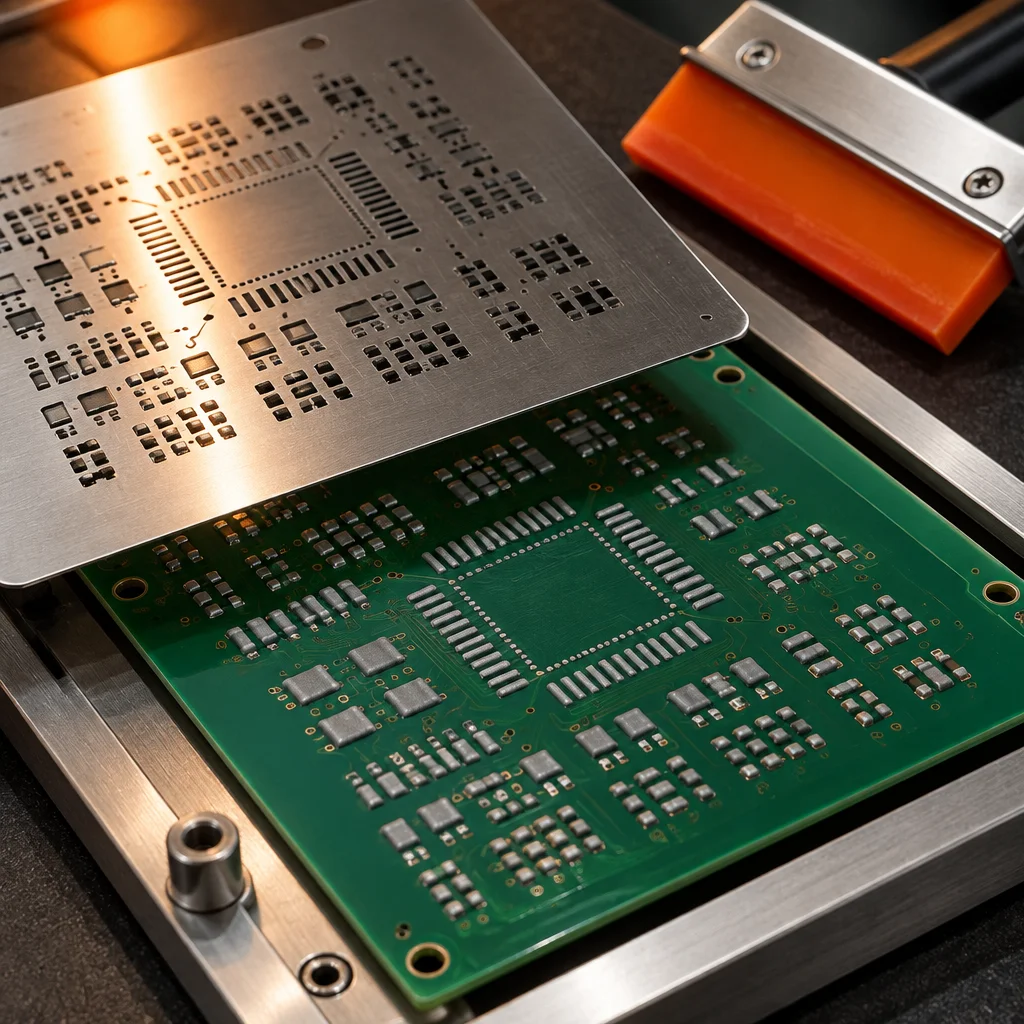
Stencils, fixtures and programming are released to the customer, or to another supplier on the customer's written instruction, after first article acceptance. Nothing about the tooling is held as leverage.
The package that crosses each stage gate
A stage gate is a documented handover. The list below is what moves with the program, and it is the same list whether the next stage is 500 boards or 50,000.
First article and DFM closure
FAI report with X-ray images, a micro-section through the finest-pitch device and dimensional data on the connector datums, plus the closed DFM item list, the released stencil data and the sample-build yield by failure mode.
Golden sample and control plan
A retained golden sample from the pilot, the production control plan with SPI, AOI and X-ray thresholds, the validated operator work instructions, the fixture qualification record and the approved deviation list.
Capability data and capacity
Capability studies on print volume and reflow profile, yield trending by failure mode across the ramp lots, the second-source component list with qualification status, and the reserved monthly capacity against your forecast.
Pilot to 30,000 units a month in nine months
A medical device manufacturer brought us a monitoring device with a six-layer board, a 0.4 mm pitch QFN and a 30-pin board-to-board connector. The first order was 25 engineering samples, released to the NPI line with a 0.12 mm stencil and hand-soldered connector joints.
The sample build produced two DFM findings that changed the layout: a mask dam under the QFN that was too narrow to hold paste, and a test-point field that could not take the fixture pitch we needed. The mask dam was fixed in revision B; the test-point problem was solved with a flying-probe programme instead of an ICT fixture, which avoided the fixture NRE at that stage.
Six weeks later a 300-unit pilot ran on the same stencil generation with a selective solder pallet for the connector, a functional test fixture and a control plan. First-pass yield on the pilot was 98.4 %, with the residue concentrated in two placement-related failure modes that were closed by a nozzle change.
The ramp followed at 2,000 units a month, then 30,000 units a month nine months after the first sample order, split between San Jose and Penang. Because the process of record never changed, the only re-qualification at the volume stage was a first article at the receiving plant and a capability study on the print and reflow stages. No new supplier, no new fixture family, no second pilot build.
Scaling questions from hardware operations
The real risk is capacity concentration, and we do not pretend otherwise. Two things reduce it: the program can be split across two plants under the same quality system with the same process of record, and the tooling is customer-owned, so a second source is a commercial decision rather than a hostage negotiation. We will also qualify a second source openly if you ask — including by releasing the stencil data, the AOI programmes and the process parameters, which is what a competent receiving supplier actually needs.
That depends on your own risk model, not on our preference. If the board is safety-relevant or your forecast is steep, dual-sourcing before ramping is usually cheaper than a line-down event: the second site first-article and capability study cost a fraction of a delayed launch. If the program is stable and the volumes are modest, a single qualified site with released tooling and a documented transfer package is normally enough. Either way we will build the transfer package to the same standard, because that is what makes the option real.
Yes. Consignment, turnkey and a hybrid of both are all supported. Hybrid is the most common at ramp: the customer consigns the long-lead and safety-critical part numbers, and we buy the commodity passives, connectors and hardware from authorised distribution. Consigned material is booked into the same 12,000 sq ft ESD-controlled store, kept in moisture-barrier packaging with desiccant and humidity indicators, and consumed FIFO against the build. Floor-life and bake records are held against the board serial number, and shortfall or damage is reported the same day. The mechanics of consignment and authorised-distribution buying are on the component sourcing page.
Start at 5 boards, plan the ramp at the same time
Send the BOM and Gerber set. The quote shows the sample price, the tooling that carries forward and the volume price you reach at 5,000 units a month — before you commit to the first build.