Aerospace and defense PCBA: AS9100D, ITAR and traceability to the reel
An avionics board is bought on evidence, not on price alone. We build to AS9100D and IPC-A-610 Class 3, handle ITAR-controlled technical data inside a registered cell with screened personnel, and can name the lot, the date code and the country of origin of every component on the assembly — down to the reel it came off.
- Quality standard
- AS9100D
- Export control
- ITAR registered
- First article
- AS9102 report format
- Workmanship
- IPC-A-610 Class 3
- Traceability
- Unit serial to lot and date code
- Record retention
- 10 years
Four constraints decide the supplier before price is discussed
Aerospace procurement rarely turns on placement accuracy. It turns on paperwork, provenance and what happens twenty years from now when a platform is still in service and the parts are not.
Country of origin is the first constraint. An assembly can be technically perfect and still be unusable if a connector, a memory device or a voltage regulator came from a source your programme does not permit. We record the country of origin for every component lot and hold the material certificates that support it, so the question is answered from the build record rather than from a supplier's word.
ITAR technical-data handling is the second. Controlled drawings, stack-ups and test specifications do not live on a shared drive. They stay inside the registered cell, on access-controlled storage, visible only to screened personnel assigned to the programme, and they are never used to quote a different customer's build.
Obsolescence over a long platform life is the third, and it is the one that gets expensive. A platform that will be supported for 20 years will see several of its components reach end of life. The answer is not a last-minute broker purchase; it is a last-time-buy modelled against annual usage, storage life and moisture sensitivity, plus alternates pre-approved in DFM so a substitution does not require a full re-qualification late in the programme.
Solderability after long storage is the fourth. Parts bought for a 20-year programme sit on a shelf for years. Every moisture-sensitive part carries a bake log and a dry-store record, and material held beyond its floor life is baked to the manufacturer schedule before it is allowed onto a line.
We do not source ITAR-restricted material from countries outside the approved list at any price or lead time. If that makes us the slower quote, it also makes us the one that survives a source inspection.
- On-shelf part numbers
- 4,000 unique MPNs
- ESD-controlled store
- 12,000 sq ft
- Moisture control
- MSL bake log per reel
- Data retention
- 10 years, IPC-1782 style
- Chamber range
- 40 °C to 125 °C
- Pitch floor
- 0.35 mm BGA
What the assembly has to survive, and the standard behind it
Each row is a requirement we hold in the routing and a result we file against the unit serial. Where a programme adds a stricter limit, it is written into the control plan for that programme only.
| Requirement | Specification held | How it is verified | Record produced |
|---|---|---|---|
| Conformal coating | Acrylic, polyurethane or silicone to IPC-CC-830, selective spray | Coverage and thickness verification with UV tracer on every coated lot | Coating record naming the material class and lot |
| Tin-whisker mitigation | Nickel barrier or tin-lead finish where the programme permits, plus coating over exposed tin | Incoming inspection and finish declaration per component lot | Finish declaration in the material certificate pack |
| Workmanship | IPC-A-610 Class 3 with J-STD-001 process control | 3D AOI after print, after reflow and post-depanel, plus 2D and 3D CT X-ray on BGA and CSP | AOI and X-ray image set per serial |
| Voiding limit | BGA and LGA void at or below 25 %, per IPC-A-610 | X-ray with slice review on first article and on any profile change | Void measurement in the first-article report |
| Fine-pitch reliability | 0.35 mm pitch BGA and 0.3 mm CSP placement at ±25 µm at 3 sigma | Placement accuracy verification plus cross-section on the first article | Cross-section images in the FAI report |
| Through-hole integrity | 0.6 mm to 6.4 mm hole fill to IPC-A-610 Class 3, nitrogen-inerted wave and selective solder | Thermal profile per assembly plus visual and cross-section verification | Profile record and hole-fill inspection record |
| Thermal screening | Chamber screening from 40 °C to 125 °C; HALT and HASS through the partner network | Chamber log with ramp and dwell recorded per run | Chamber run log and functional result |
| Vibration screening | Vibration and drop screening through the qualified partner network, to the programme profile | Fixture-mounted run with before-and-after functional test | Pre and post test data in the release pack |
| Rework and repair | IPC-7711/7721 with operator certification maintained on a renewal cadence | Every rework operation logged with the operator identification | Rework log attached to the unit serial |
The control set around a controlled programme
Aerospace and defense work runs on the same six SMT lines as every other programme. The difference is that the data, the people and the physical build cell are separated from the rest of the plant.
We are ITAR registered. Controlled technical data is stored on access-controlled systems inside the registered cell and is visible only to screened personnel assigned to that programme. Build cells for controlled work are physically segregated, and drawings are never printed to a shared printer or left on a line bench. When a programme ends, access is revoked and the file is retained for 10 years rather than archived to an open share.
Source inspection is welcome. If your quality representative wants to witness first article, review cross-sections or pull the routing for a specific serial, we book the visit and provide the records. Customer-supplied test equipment, golden samples and inspection fixtures are handled under the same control as customer components.
- ITAR-registered handling with segregated, access-controlled data
- Screened personnel assigned to controlled programmes
- Physically segregated build cells for controlled work
- Source inspection and customer audit by appointment
- Counterfeit avoidance to AS6081 practice on incoming material
- Country-of-origin record held for every component lot
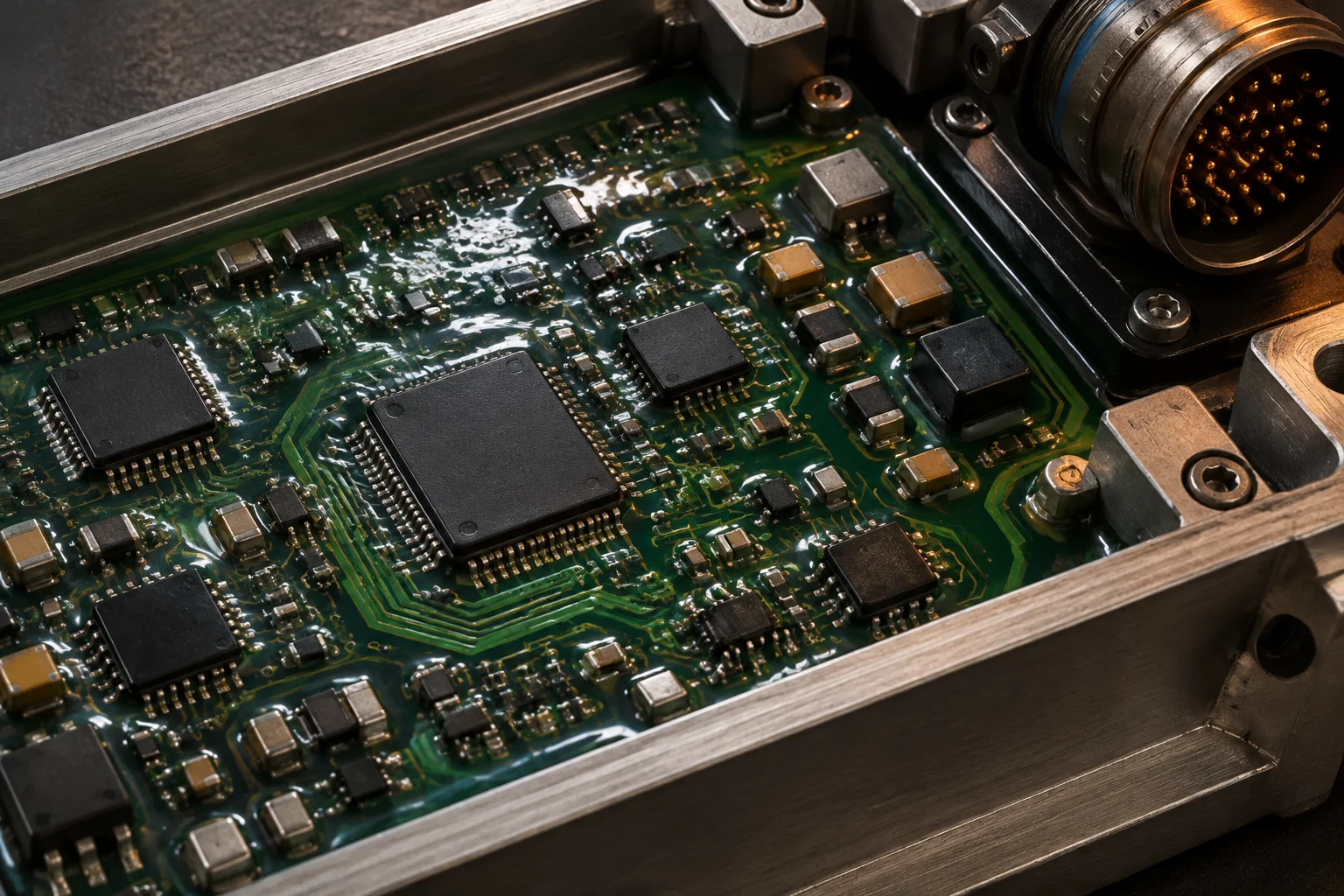
From the reel to the serial number
Traceability to the reel is not a database feature; it is a sequence of physical records created at specific points, each one tied to the previous one. Here is the chain a serial number resolves to.
-
Incoming
Component receipt and inspection
Parts arrive from authorised or franchised distribution only. Each lot is checked against the purchase order for part number, quantity, date code and country of origin, then inspected for marking, packaging and moisture-barrier integrity. Suspect material is handled to AS6081 practice — quarantined, documented and dispositioned, never returned to stock on a verbal decision.
-
Store
Reel-level storage and moisture control
Components are held in a 12,000 sq ft ESD-controlled store with 4,000 unique part numbers on the shelf. Moisture-sensitive reels carry a bake log and a dry-store record. Shelf-life status is visible at kitting, so a reel that has exceeded its floor life cannot be issued to a line without a bake.
-
Kitting
Kitting to the work order
Every reel, tube and tray issued to a build is scanned against the work order, so the material lot list is fixed before the first board is printed. That list is what makes a recall scope finite: we can name every serial that contains a specific material lot without re-scanning the store.
-
Build
Serialisation on the line
Each assembly is serialised at board level. The serial is bound to the SPI result from the print gate, the reflow profile that ran, the AOI result after reflow, the post-depanel inspection and the X-ray data where the assembly carries BGA or CSP devices. Records are written in an IPC-1782-style structure and retained for 10 years.
-
Release
Test, certificate and shipment
Functional test results, the certificate of conformance and the material certificate pack are attached to the same serial before packing. Packing uses moisture-barrier material with desiccant and a humidity indicator card, and the shipment record closes the chain from reel to delivered unit.
Documents and certifications you receive
Every shipment carries the evidence the programme was quoted against. Certificate numbers are never published; copies are released under NDA.
The first-article report uses the AS9102 structure and carries X-ray, cross-section and dimensional data, including void measurements against the 25 % limit in IPC-A-610. Alongside it, every lot ships with a certificate of conformance, laminate and material certificates, and the traceability record that links the unit serial to the component lots and date codes inside it.
Counterfeit avoidance follows AS6081 practice, with authorised or franchised sources only, incoming inspection on every lot, and X-ray or decapsulation escalation when a part is suspect. Conflict-minerals due diligence follows the OECD framework with smelter reporting available on request.
- Quality standard
- AS9100D
- Quality base
- ISO 9001:2015
- Environmental
- ISO 14001:2015
- Workmanship
- IPC-A-610 Class 3, J-STD-001
- Rework
- IPC-7711/7721
- Coating
- IPC-CC-830
- ESD programme
- ANSI/ESD S20.20-2021
- Laminate
- UL 796 recognition
- Export control
- ITAR registered
- Retention
- 10 years

A flight-control sub-assembly with a 20-year availability plan
Anonymised as required. No customer name, no platform, no part numbers — the planning problem is the point.
An avionics integrator brought us a flight-control sub-assembly with an 8-layer stack, two 0.35 mm pitch BGAs and a support commitment measured in decades. The design was already frozen, so the first job was not layout advice; it was a buildability review against a 20-year horizon.
DFM identified three components with published end-of-life risk. With the customer we modelled annual usage against storage life and moisture sensitivity, and set a last-time-buy quantity for each — enough to cover the remaining production plus spares, stored in the ESD-controlled area with bake logs and dry-store records rather than left in open stock. Approved alternates were agreed for two more parts, so a future substitution would not restart qualification from zero.
First article ran to IPC-A-610 Class 3 with an AS9102 report, cross-sections on both BGAs and a void measurement against the 25 % limit. The assembly is coated to IPC-CC-830 and every unit is serialised to a lot and date code. Production repeat orders run 3 to 4 weeks ARO under the existing programme, and the test fixture and programming are owned by the customer after first article.
Three end-of-life risks on a frozen design with no room to re-layout. The answer was a modelled last-time-buy plus two pre-approved alternates, agreed before the first production order rather than after the first line stop.
Questions aerospace buyers ask us
Tell us the classification at RFQ, not after the order. If a drawing or test specification is export controlled, it is held inside the ITAR-registered cell on access-controlled storage, visible only to screened personnel on the programme, and it is never used to benchmark or quote another customer's build. At the end of the programme, access is revoked and the file is retained for 10 years rather than moved to an open archive.
Yes, by appointment. Source inspection can cover first article, in-process gates, final inspection, or the build record for a specific serial including its SPI result, reflow profile, AOI images and X-ray data. Bring your own inspection equipment if the programme requires it; we will give you a bench, the routing and the records. Audits of the wider quality system under AS9100D and ISO 9001:2015 are also hosted on site.
We review the bill of materials for lifecycle status during DFM and flag anything with end-of-life risk before the design is frozen where possible. For long programmes we model annual usage, storage life and moisture sensitivity, then agree a last-time-buy quantity with the customer and hold the material in the ESD-controlled store with bake logs and dry-store records. Alternates are pre-approved in DFM so a substitution later does not restart qualification, and 4,000 unique part numbers already sit on our shelf for the programmes we run.
Send the drawings and the classification
Tell us the standard, the export classification and the support horizon. DFM review comes back in 24 hours, a firm quote in 48, and the traceability and documentation requirements are priced in from the first revision.