Request a quote — DFM in 24 hours, firm price in 48
Send a BOM that carries manufacturer part numbers and a Gerber set that carries a stacked drill file. A process engineer — not a sales desk — reads both, lists every buildability risk, and prices the assembly exactly as described. No price that moves after tooling.
- DFM report
- 24 hours
- Firm turnkey quote
- 48 hours
- Files we read
- RS-274X · Excellon · IPC-356
- Confidentiality
- Mutual NDA by default
- Prototype MOQ
- 5 units
The RFQ form — every field a process engineer actually needs
Fill in what you know and leave the rest blank. A blank field becomes a question in the DFM report; a wrong field becomes a re-quote three days later. Quantities, layer count and assembly type are what move the price, so they are the fields we ask for first.
An RFQ that arrives before 15:00 PT is triaged the same day. Anything arriving after that starts at 07:00 PT the next working morning, because the DFM reviewer and the sourcing desk both have to see it before the clock starts.
Prefer to talk it through first? Call +1 408 555 0142 or read how an order runs.
What to attach, and in what format
Nine files cover almost every quote. If one of them is missing we still start the DFM review and send you a short gap list — but the quote holds at estimate status until the last file lands.
| Deliverable | Format we read | What the reviewer checks first |
|---|---|---|
| Fabrication data | Gerber RS-274X, one file per copper, mask and silk layer | Layer count against your stack-up note, solder-mask web on the finest pitch, annular ring on every via |
| Drill data | Excellon, plated and non-plated as separate files, units stated | Tool sizes against pad diameters, drill-to-copper clearance, whether the file is stacked or by-layer |
| Netlist | IPC-356-D or IPC-D-356A | Net count against the BOM, plus any net that appears on one layer only |
| Bill of materials | CSV or XLSX, one row per unique part | Manufacturer part number, reference designators, quantity per board, package, and lifecycle status |
| Assembly drawing | PDF, top and bottom views | Polarity marks, connector orientation, torque callouts, keep-outs for coating and masking |
| Centroid data | XYRS, comma or tab separated | Rotation convention for fine-pitch parts, and whether the origin matches the Gerber origin |
| Panel requirement | Your panel drawing, or a note saying "panelise for us" | Rail width, fiducial placement, breakaway method, and whether the panel fits a 610 × 510 mm frame |
| Test specification | PDF or spreadsheet | Coverage target, test-point access, pass and fail limits, and what the fixture has to report back |
| Quality notes | Any document you already have | Workmanship class, conformal coating type, cleaning limits, serialisation and labelling rules |
A stacked drill file is workable. A drill file that is missing entirely is not, because plated and non-plated holes decide the process routing and the number of drill passes. If you cannot export drill data, send the fabrication drawing and we will quote the assembly and flag the board as customer-supplied.
How the 48 hours is actually spent
The clock starts when the file package is complete, not when the first email arrives. Here is the hour-by-hour sequence a turnkey quote follows.
-
Hour 0 – 2
Intake and file validation
An order engineer opens the archive, counts layers, checks that the drill file parses, and runs the BOM through the ERP to see which lines are already in the 4,000 part numbers held on the shelf. You get one email listing anything that did not open.
-
Hour 2 – 6
DFM review against real process limits
The DFM reviewer checks pad geometry against land patterns, 0.35 mm pitch BGA escape routing, mask slivers, component-to-component clearance for the placement heads, and whether the panel breaks away without stressing a 01005 part. Every finding is written as a change with a cost or a schedule effect attached.
-
Hour 6 – 12
Sourcing and lifecycle check
The sourcing desk prices each BOM line at the quantity you asked for, flags parts with a lead time beyond your target date, and proposes one pin-compatible alternate per flagged line. Alternates are never substituted silently — they come to you for approval in writing.
-
Hour 12 – 24
Process routing and tooling plan
Routing fixes the stencil foil thickness between 0.10 mm and 0.20 mm, the reflow profile window, whether the build needs selective solder or a wave pallet, which gates run SPI, AOI and X-ray, and whether a test fixture has to be designed. Fixture NRE is quoted as a separate line.
-
Hour 24 – 36
Cost model
Cost is built from material at the quoted break, machine time at the line rate, labour for any hand operation, tooling, fixture and freight. NRE is shown as its own line so you can see what disappears at volume: it is $0 on a standard single-sided SMT build.
-
Hour 36 – 48
Second-engineer review and release
A second engineer re-reads the DFM findings against the quote lines. If anything is not supported by a number in the file set, it goes back. The quote leaves as a PDF with the DFM report attached, a stated validity window of 30 days and the payment terms written on the face of it.
How price responds to quantity
Two costs behave differently as quantity rises. Setup and tooling are one-time and get smaller per unit; material and machine time scale almost linearly, then step down when a part crosses a distributor reel break or when the build moves onto a dedicated line.
| Band | Setup and NRE | What drives the unit price |
|---|---|---|
| 5 to 50 units | NRE $0 on standard single-sided SMT; stencil charged as a tooling line | Handling and programming dominate. Material is bought at cut-tape or partial-reel pricing. |
| 51 to 500 units | Same setup; fixture NRE quoted separately if test is required | Programming cost is spread thin; reel breaks start to reduce material cost. |
| 501 to 5,000 units | Fixture NRE is credited in full at 5,000 units | Line changeover is amortised across a full shift; kitting is planned as a kit, not per board. |
| 5,001 to 45,000 units | No repeat NRE under an existing programme, no MOQ | Machine time at the line rate plus material at full-reel breaks. 21 to 28 days ARO per release. |
- Tooling — stencils, fixtures and programming — transfers to you as your property after first article.
- An annual blanket order with monthly releases holds one material price for the year.
- Consigned material is welcome; it is kitted and inspected on arrival and shortages are reported within one working day.
- Ask for the price at three quantities in the RFQ notes and you get three columns back, not three quotes.
The requirements that change the price as much as the Gerbers do
Two boards with identical Gerbers can price 40 % apart, because the requirements that sit outside the artwork decide how many process steps the build needs.
RoHS and REACH
State whether the assembly must meet RoHS 2011/65/EU with the (EU) 2015/863 amendment, and whether any REACH SVHC above 0.1 % w/w is acceptable. A leaded exemption changes the alloy and the reflow window, so it changes the profile.
Workmanship class
IPC-A-610 Class 2 and Class 3 use the same machines and different inspection limits. Class 3 adds vertical fill and fillet requirements that slow the line, and it changes what the X-ray reviewer is allowed to pass on a BGA.
Coating and cleaning
Acrylic, polyurethane or silicone coating to IPC-CC-830, applied by selective spray with masked connectors and test points. Aqueous cleaning is verified by ionic contamination test to a J-STD-001 limit of 1.56 µg NaCl-eq/cm².
Serialisation and records
Board-level serialisation with MES records held for 10 years in IPC-1782 style. Tell us the serial format, where the label or laser mark goes, and whether you need the data as a file at the end of the build.
Packaging and labelling
ESD bag, desiccant, humidity indicator card and a foam or tray stack that survives the carrier. Carton labels can carry your part number, revision, quantity, date code and country of origin.
Box build and integration
If the quote includes harnesses, an enclosure or a firmware load, say so at RFQ stage. Integration adds a separate routing, a separate test step and often a separate fixture.
What we will not price blind
Four things we ask you to fix before the quote is issued. Each one is cheaper to fix in the file than on the line.
BOM rows without a manufacturer part number
A description like "100 nF 0402" is not a purchasable part. Send the manufacturer part number, the manufacturer and the reference designators. If the part is generic, say which parameters are free and which are locked.
An ambiguous surface finish
If the fabrication note says "gold" we cannot tell ENIG from hard gold on a connector edge. Write the finish and the thickness you need, and note which areas must not be coated or masked.
A drill file that will not parse
Excellon files exported without units, or with plated and non-plated holes merged, cost a day to untangle. Export the two hole types as separate files and state the units and the number format.
No quantity and no date
Price is a function of quantity and schedule. "How much for 1,000?" without a target date is a range, not a quote. Give both and you get a firm number with a delivery week attached to it.
An incomplete package still gets a DFM review and a gap list, usually inside 24 hours. We would rather tell you on day one that a 0.2 mm via needs a different drill schedule than find it during first article.
NDA, ITAR and who can see your files
Your files are not a sales asset. They are process input for one programme.
A mutual NDA is the default on every RFQ, signed before the first file is opened if you prefer your own paper. Nothing in the package is shared with a distributor, a fabricator or a fixture shop until a purchase order exists, and then only the drawing that supplier needs to do the work.
Defense work is handled under our ITAR registration. ITAR-controlled technical data stays with US persons inside the San Jose plant, is never copied to the Penang site, and is stored on the access-controlled programme share rather than the general engineering drive.
Quote and RFQ data is retained for 24 months so that a re-quote or a repeat build does not start from zero. Manufacturing records — serial numbers, MES process data, inspection results and material certificates — are retained for 10 years in IPC-1782 style, which is what an audit trail for a medical or aerospace programme usually demands.
No customer name, logo or programme detail is ever published. Case material on this site is anonymised by industry and region, and anything closer than that is released only with your written consent.
Procurement terms, on one screen
- Minimum order
- 5 units for a prototype build; no MOQ on a production repeat under an existing programme
- NRE
- $0 on standard single-sided SMT; fixture NRE quoted separately and credited at 5,000 units
- Payment
- Net 30 with approved credit; Net 15 on a first order; card accepted under $10,000
- Tooling ownership
- Stencils, test fixtures and programming become your property after first article
- Warranty
- 12 months on workmanship, against the IPC-A-610 class specified on the drawing
- Quote validity
- 30 days from issue, or the material price validity window if that is shorter
- Lead time, prototype
- 5 to 8 days with standard parts; 8 to 12 days with consigned or long-lead parts
- Lead time, production
- 21 to 28 days ARO; 4 to 5 weeks for a turnkey ramp with full kitting
- Standards
- ISO 9001:2015, ISO 13485:2016, IATF 16949:2016, AS9100D, J-STD-001, IPC-A-610
Questions that arrive with the RFQ
Yes, when the line has capacity and the material is on the shelf. A rush changes the sequence, not the engineering: DFM still happens, and the build moves to the NPI and flex line in San Jose rather than waiting for a volume changeover. Expect a premium for expedited material and for a second shift, quoted as its own line so you can decline it. If a part has a lead time longer than your date, no amount of premium fixes it — we will tell you the same day and propose an alternate.
Yes. A transfer quote needs three things beyond the file set: the current assembly revision that is actually being built, the test fixture and programming files, and a golden sample or the last known-good unit. We compare your incoming board against our first article and report every difference before the first production release. The first release normally runs as a pilot under the same first-article sign-off as a new product introduction, which takes 15 days after DFM sign-off.
No. We build five units at prototype pricing and you get the real process, the real materials and the first article report — including X-ray, cross-section and dimensional data. A free sample would either come off a different process or be given away, and neither tells you how your board behaves at 45,000 units a month.
More detail on routing, file expectations and programme transitions sits in the procurement FAQ and the DFM design guides. If the quote needs a conversation, contact the engineering desk.
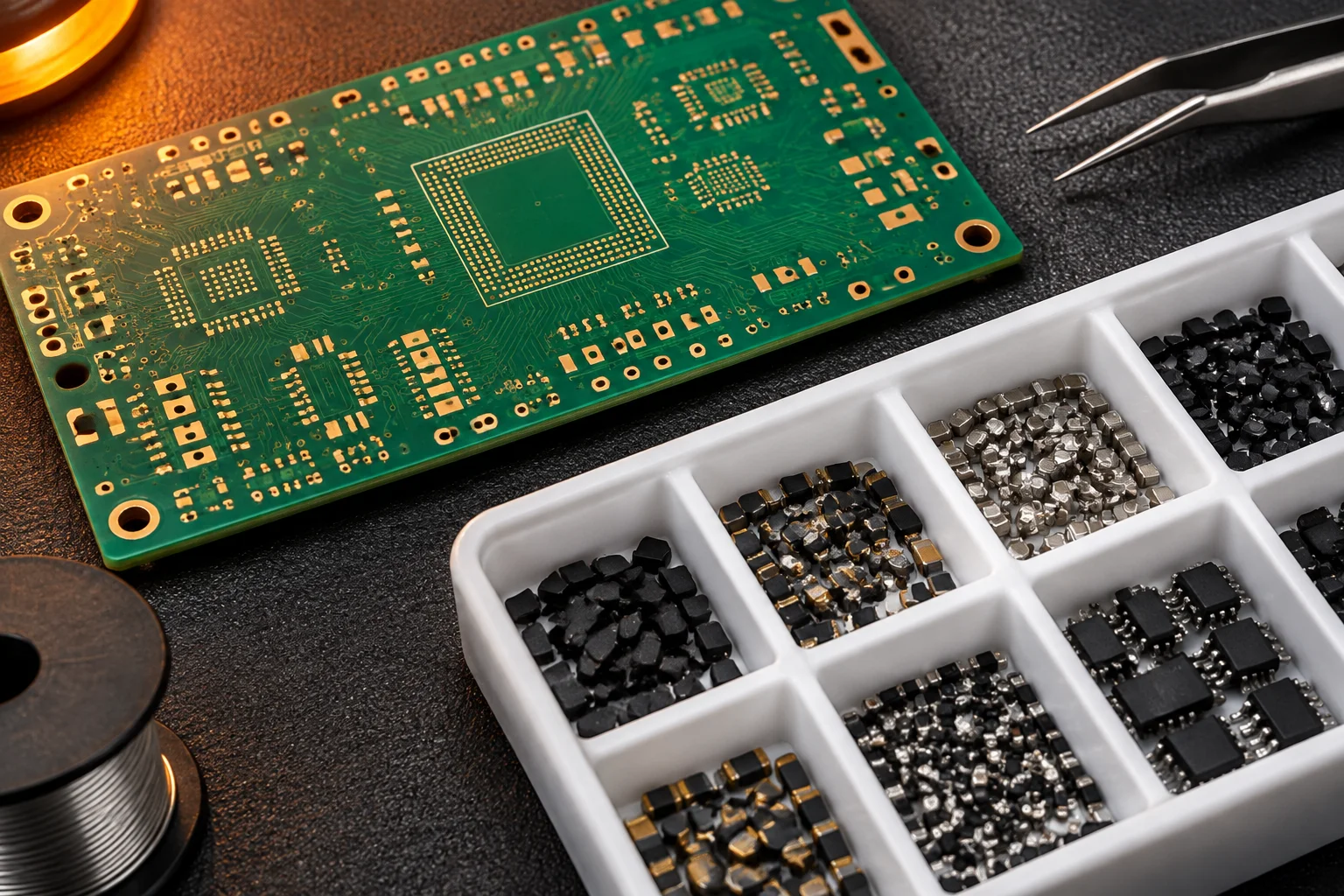
Send the BOM and the Gerbers. We will send the risks back first.
A DFM report in 24 hours, a firm turnkey price in 48, and a named process engineer on the other end of the thread.