Programme examples

Programmes we can talk about, without naming names

NDA is the default here, so no customer name, logo, part number or product name appears on this page. What does appear is the engineering: board class, volume, workmanship standard, what made the build hard, and what we changed.

Active programmes
130
In NPI right now
38
Customers since 2009
400+
Plants carrying them
2
SMT lines
6
Record retention
10 years
02 / Anonymity

Why there are no logos on this page

Most of the 130 programmes running through San Jose and Penang are covered by a mutual NDA that predates the purchase order. That agreement covers the customer's name, the product, the schematic, the BOM, the volumes and the fact that we build it at all. A case study that names the customer would break it, and a case study that names the product usually breaks it too, because a medical or automotive product is identifiable from its description alone.

So the cases below are described by what they demanded from the process: board construction, assembly class, volume band, standards applied and the specific problem that made them interesting. Where a detail would identify the customer it has been generalised rather than invented — if a figure is approximate, the text says so.

If you need a reference you can actually call, ask. With the customer's permission we will arrange a direct reference call with a programme of similar class, volume and industry. That happens in a minority of cases, because most customers prefer not to be named even to a peer, and we treat a refusal as the default rather than an insult.

What we will not publish

Customer names, logos, product names, part numbers, schematic detail, unit prices and volumes tied to an identifiable design. No exceptions, including for customers who would agree.

What we will publish

Board class and layer count, volume band, workmanship standard, process sequence, inspection gates used, and the engineering change that made the difference.

03 / Flagship cases

Three programmes, three different kinds of hard

One is hard because of the documentation, one because of the current, one because of the process sequence. Different problems, different fixes.

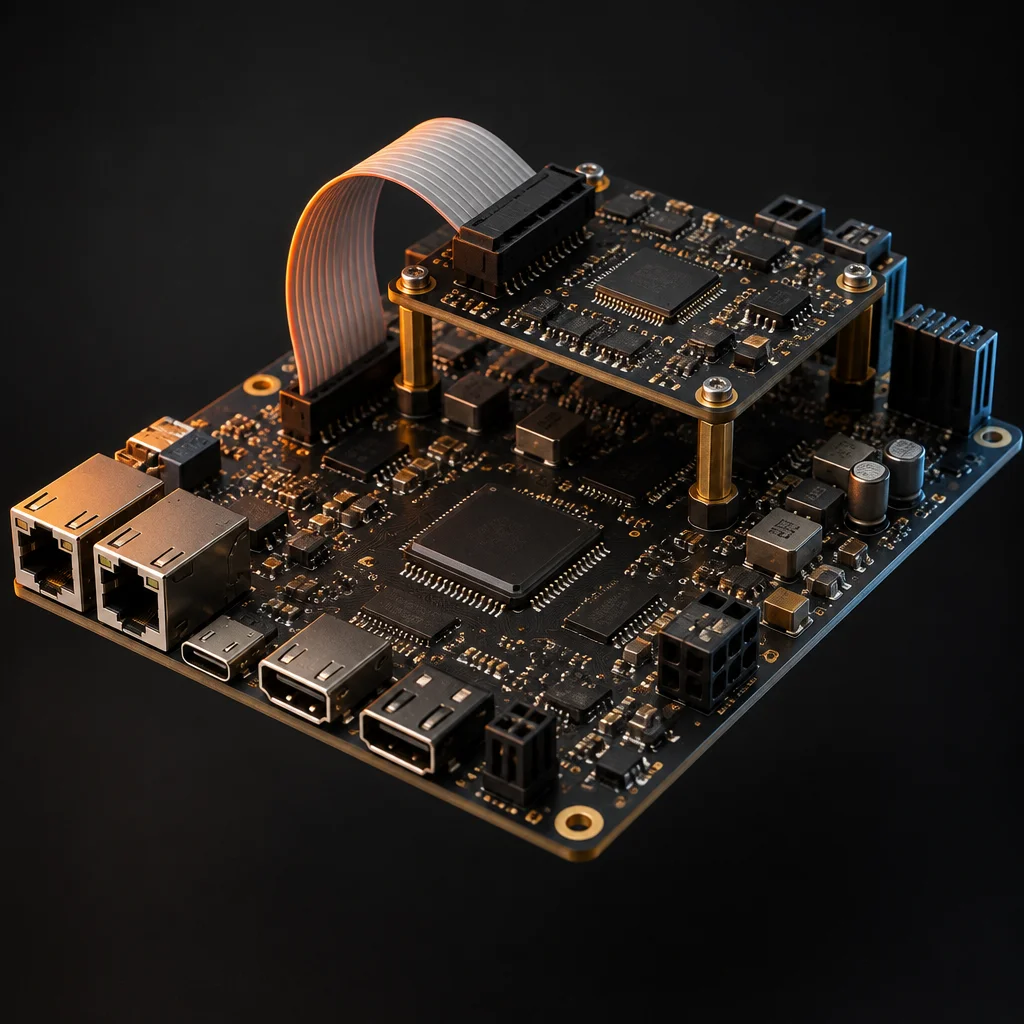
A finished multi-board assembly against a dark background, a daughter card stacked on standoffs above a main board

Infusion pump control board

Medical · IPC-A-610 Class 3 · 2,000 units/month

A Class III assembly for a device manufacturer in the Upper Midwest, running at 2,000 units a month on a six-layer board with a 0.4 mm pitch QFN and two fine-pitch packages. The soldering is not the hard part. The hard part is that every unit needs a device history record that reconciles component lots, operator, inspection results and test data into one file, and that file has to survive an audit years later. The controls behind it are described under medical devices.

We run it with 100 % X-ray on both area-array packages, ionic contamination testing on every cleaning batch, and serialisation written at the printer so the DHR builds itself as the board moves. Records are retained for 10 years.
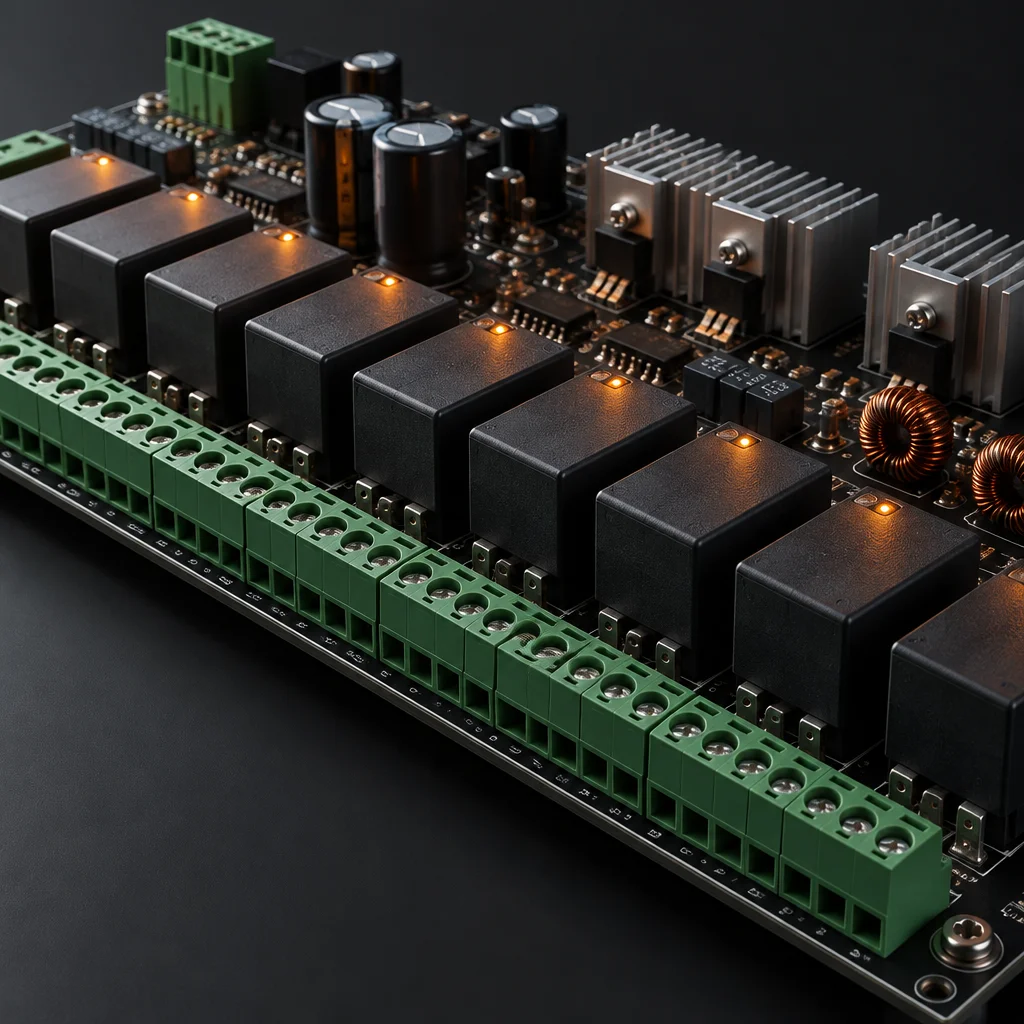
A control board photographed at a raking angle, a row of relay cans and a screw-terminal block along the near edge

EV charger battery management board

Automotive & EV · IATF 16949:2016 · 20,000 units/month

A battery management assembly carrying a 400 A bus, which means heavy copper, a lot of thermal mass and joints that will not reflow on a standard profile. The build runs selective soldering on the bus bars with a pallet designed in-house to isolate the SMT side from the heat, and the profile is verified with thermocouples on every panel of the first article.

The programme releases under a PPAP level 3 submission, so the control plan, MSA on the test fixture and the process capability data were all signed off before the first production order. 20,000 units a month now run across two lines, under the automotive requirements set out for automotive and EV.

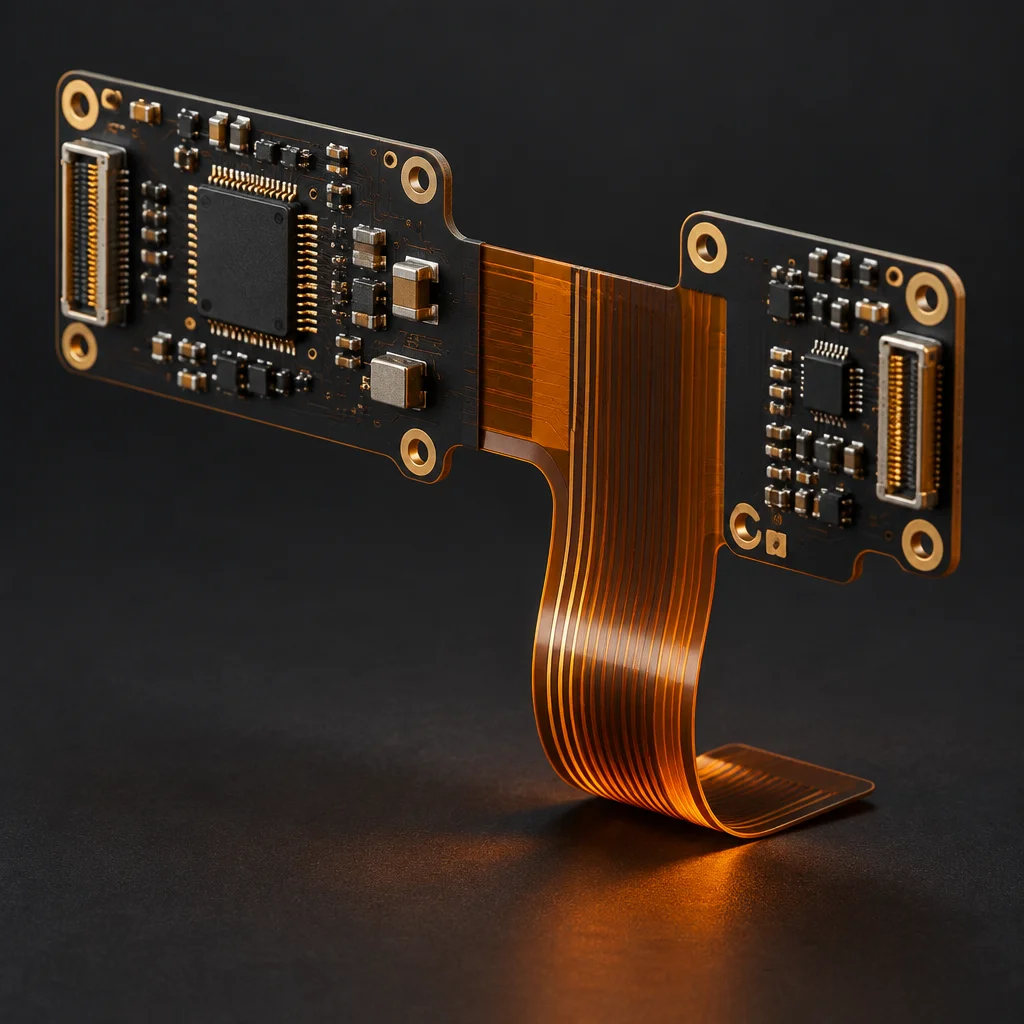
A rigid-flex assembly standing on edge, the polyimide flex tail curling forward under its own weight

Eight-layer industrial controller

Industrial · IPC-A-610 Class 2 · 3 passes to 2

This one arrived as a three-pass build: reflow, wave, then a hand-soldering operation for the connectors that could not take the wave. Three thermal cycles on an eight-layer board with a large ground plane is a reliability problem as well as a cost problem, because each pass is another chance to damage a connector or shift a joint.

We moved the through-hole connectors to pin-in-paste, revised the stencil apertures to hit the paste volume the barrels needed, and removed the wave step entirely. Two passes instead of three, one fewer thermal cycle, and a hand-solder operation eliminated. It is the pattern we look for on any board in this class — see industrial automation for the wider requirements.

04 / Case table

The same three programmes, in the numbers

Anonymised programme comparison
ProgrammeIndustryBoardVolumeClassWhat made it hardWhat changed
Infusion pump controlMedical devices6-layer, 0.4 mm QFN plus two fine-pitch packages 2,000 units/monthIPC-A-610 Class 3 Device history records had to reconcile lots, operators, inspection and test into one auditable file Serialisation written at the printer so the DHR builds itself; 100 % X-ray on both area-array packages
EV charger BMSAutomotive & EVHeavy copper with a 400 A bus and large thermal mass 20,000 units/monthIPC-A-610 Class 2 Bus joints would not reflow on a standard profile without cooking the SMT side In-house selective solder pallets, per-panel thermocouples, PPAP level 3 before the first production order
Industrial controllerIndustrial automation8-layer with a large ground plane and wave-soldered connectors 3,500 units/monthIPC-A-610 Class 2 Three thermal cycles per board and connector damage at the wave pot Connectors moved to pin-in-paste with revised apertures; the wave step removed, three passes down to two

Volumes are the steady-state monthly run rate for the programme at the time of writing, rounded. They are quoted with the customer's general agreement on the description and without any identifier, and the third programme's run rate covers both lines it now shares.

05 / Small programmes

The five-board prototypes that became production

A good share of the 130 active programmes started as an order for 5 boards. That is deliberate on our side: the prototype minimum is 5 boards, the NRE is $0 on a standard single-sided SMT build, and the same process engineer stays with the design from the first article through to the repeat order. There is no separate prototype team that hands a folder to production and disappears.

The pattern usually runs the same way. Five engineering samples to prove the design, then 50 to 500 units for a pilot, then a ramp. What changes at each step is not the supplier but the amount of process data: the pilot run adds a control plan and a fixture, and the ramp adds reserved line time and a bonded component stock position.

Two of the programmes in the table above began under 100 units. One is now at 20,000 units a month. The transition that mattered was not capacity — it was documentation. Moving from a 50-unit pilot to 20,000 units a month means the fixture is validated with an MSA, the control plan is written, the AOI recipe is locked, and the customer's PPAP submission has real capability data behind it instead of a sample report. The staged process for that ramp is described on prototype to production.

That work happens once, at the pilot stage, and it is why a programme that ramps through a pilot run costs less to transfer than one that jumps straight from 5 boards to volume with nothing in between.

06 / Recovery

One programme we lost, and what changed afterwards

We lost a consumer programme to a competitor after two years. The boards were good; the ramp was not. The customer doubled their forecast in a quarter, we accepted the increase without re-quoting the lead time, and then missed three consecutive ship dates because the component position behind the increase had not been bought. Nobody had told the customer that a doubling in volume needs a new material commitment, and nobody had told us that their forecast had changed until the purchase orders arrived at the higher number.

What changed: a forecast now triggers a written capacity and material response within 5 working days, naming what can be supported at the current lead time and what needs a new commitment. If we cannot support an increase, we say so in that response rather than at the ship date. Programmes above 10,000 units a month also carry a named material planner, and the rolling 12-month forecast is a line item in the monthly programme review for both sides.

We still lose programmes, usually on price for a design with no process difficulty. What we try not to do is lose one on a promise we could not keep.

The 5-working-day rule

Any forecast change gets a written response inside 5 working days: what the current lead time supports, what needs new material commitment, and what the new date would be.

Named owner

Programmes running above 10,000 units a month carry a named material planner and a named process engineer, both listed on the quote.

07 / Transfers

What we check before taking a transfer programme

The assembly is buildable as drawn

Panelisation, fiducials, tooling holes and land patterns against IPC-7351B. If the current supplier is building it successfully, we want to know how — the stencil specification, the profile and the fixture design tell us more than the drawing does.

The parts can be secured

Every line on the BOM is checked for lifecycle status and authorised availability. A transfer that lands in the middle of a last-time-buy is a transfer that was not ready, and we would rather say that at DFM than after the tooling is paid for.

The test strategy survives

Existing fixtures, test programs and boundary-scan chains are reviewed before transfer. If the fixture is not transferable, the fixture NRE is quoted up front and credited back at 5,000 units so it is not a hidden adder to the unit price.

The documentation is complete

Assembly drawing, workmanship class, coating requirement, labelling and serialisation scheme, packaging standard and any customer-specific acceptance criteria. Each of these changes the build, and a missing one turns into a rework order.

The volume is real

A monthly run rate and a 12-month forecast, not a theoretical peak. The 45,000 unit monthly ceiling across both plants is finite, and a new programme competes for line time with everyone else's ramp unless a forecast reserves it.

The exit is planned

Tooling, stencils, fixtures and programming belong to the customer after first article. If you leave, you leave with them, along with the process documentation needed to rebuild the programme elsewhere. That is stated in the terms rather than negotiated on the way out.

08 / Programme clock

What the first six weeks of a new programme look like

  1. Week 1

    Files in, DFM out

    Gerber, drill, BOM and test requirements are logged and read by an engineer. A written DFM report follows within 24 hours and a firm quote within 48, with alternates for long-lead lines and the lead time each one implies.

  2. Week 1

    DFM sign-off

    The customer approves or rejects each recommended change in writing. Workmanship class, coating, labelling and packaging are fixed here, because all four change the process and none of them can be added at final inspection.

  3. Week 2

    Stencil, programming and kit

    The stencil is laser cut in 4 hours from the approved Gerber. Placement programs are generated from the centroid file and verified, the AOI recipe is built, and the component kit is pulled from the 4,000 part numbers on the shelf or ordered against the approved alternates.

  4. Week 3

    First article

    The pilot run builds 15 working days after DFM sign-off. It carries an FAI report with X-ray, cross-section and dimensional data, a golden sample and the SPI and AOI results, and the customer signs it off before production is released.

  5. Week 4 to 6

    Production release and ramp

    Line time is assigned, the control plan travels with the work order, and process data accumulates per serial number. A repeat order under the released programme has no MOQ and runs in 3–4 weeks ARO; a turnkey ramp with full kitting takes 4–5 weeks ARO.

09 / References

References, samples and site visits

Reference calls are arranged with the customer's written permission, matched to your industry, assembly class and volume band. We will tell you honestly how many of the last ten requests were approved — most are not, because a customer who values their NDA usually values it against a peer as much as against a public web page.

Sample boards are a different question and an easier one. We can show you assemblies we have built that are no longer in production or that the customer has released, with all identifying markings removed, and we can walk the process data from those builds with you at the bench.

A site visit is normally the most useful of the three. Bring a board or a Gerber set and we will run the package through DFM while you are in the building, show you the line it would be assigned to, and pull the SPI and AOI data from a comparable panel size so you can see what the gates actually produce rather than what a brochure claims.

Audit rights, reference permissions and the confidentiality terms around all of the above are handled under the same mutual NDA that covers the programme, so nothing here requires a new agreement to start. If you want to see the sequence a new programme follows from intake to shipment, that is set out on how an order runs.

10 / Questions

Questions about the programmes on this page

Not from this page, and not on a sales call. NDA is the default across the 130 active programmes, and a description specific enough to be useful is usually specific enough to identify the customer. What we will do is ask a named customer whether they are willing to take a reference call with you, and accept their answer either way.

Yes. Source inspection and witnessed first articles are routine for medical, aerospace and automotive programmes. Visits are scheduled with two weeks of notice so your product is genuinely on the line during the visit, and a customer inspector can witness the SPI, AOI and X-ray gates for their own assemblies.

We do not sell stock assemblies, because the only sample worth showing you is built to your own drawing. What you can order is a 5-board prototype run on the NPI line — NRE is $0 on a standard single-sided SMT build, prototypes take 5–8 working days with standard parts, and the first article comes with X-ray, cross-section and dimensional data.

Your programme would be the 131st, and it would start the same way

Send the Gerber and the BOM. You get a DFM report in 24 hours, a firm quote in 48, and the name of the process engineer who would own the build.

Active programmes130 Since 2009400+ customers Prototype MOQ5 boards