PCBA for medical devices: ISO 13485:2016 discipline from first article
We build Class II and Class III non-implantable assemblies under ISO 13485:2016, on top of an ISO 9001:2015 base. Every unit is serialised, every lot is released by quality assurance against a control plan, and every build record is written while the board is on the line — not reconstructed from memory when an auditor asks.
- Governing standard
- ISO 13485:2016
- Devices built
- Class II / Class III, non-implantable
- Traceability
- Unit serial to MES record
- Record retention
- 10 years
- Default workmanship
- IPC-A-610 Class 3
- Ionic cleanliness
- ≤ 1.56 µg NaCl-eq/cm²
What medical buyers get wrong about the board house
Most medical assembly problems are not placement problems. They are record problems and chemistry problems, and both are decided long before the first board reaches the reflow oven.
The first mistake is treating cleanliness as a cosmetic property. For a coated or sealed assembly, flux residue left under a conformal coat is a chemical reservoir: it can trap ionic species, shift leakage current and, on a device that touches a patient, raise a residue question that no amount of final inspection will answer. We hold ionic contamination to 1.56 µg NaCl-eq/cm² or below on every washed lot, measured per J-STD-001, and we record the number rather than the pass mark.
The second mistake is assuming that a board house can change anything quietly. A paste alloy change, a laminate change, a coating-material change or a move of the work order to a second plant are all changes to a validated process. Under ISO 13485:2016 the medical device manufacturer owns that validation, and it cannot own what it was not told about. We notify in writing before implementation, every time, including when the change would save us money.
The third mistake is commissioning the device history record after the fact. A device-history-style build record is a contemporaneous document: the reflow profile that ran, the SPI result that gated the print, the AOI and X-ray results, the cleanliness result, the coating material lot and the operator who signed for each stage. If it is written from the work order three days later, it is a story, not a record. We generate it as the lot moves, tied to the unit serial.
The fourth mistake is leaving patient-contact materials to the last conversation. If an assembly or its coating will touch a patient, the material declaration has to be settled in DFM, before the BOM is frozen, because swapping a housing or a coating material after first article restarts the customer's own verification work.
A quote that does not mention cleanliness, coating material class or record retention is not a cheaper quote. It is a quote for a different product, and the gap shows up at your next supplier audit.
- DFM review
- 24 hours
- Firm quote
- 48 hours
- Prototype build
- 5 to 8 working days
- NPI pilot run
- 15 working days after DFM
- Production repeat
- 3 to 4 weeks ARO
- Prototype MOQ
- 5 boards
The requirements, the limit and the evidence behind each one
Every row below is a specification we hold on the shop floor and a record you receive with the lot. Nothing here is aspirational; each item is measured and filed.
| Requirement | Specification held | How it is verified | Record produced |
|---|---|---|---|
| Ionic contamination | 1.56 µg NaCl-eq/cm² maximum, per J-STD-001 | Inline aqueous cleaning followed by an ionic contamination test on every washed lot | Cleanliness result filed against the lot serial |
| Flux residue | No visible residue; no-clean allowed only where the board is sealed and uncoated | Microscope inspection at 10x plus the ionic result | Inspection record with images |
| Conformal coating | Acrylic, polyurethane or silicone to IPC-CC-830, applied by selective spray | Coverage and thickness check with UV tracer | Coating record naming the material class |
| Wash or no-clean | Water-wash for every Class 3 or coated assembly; no-clean only for sealed, uncoated boards | Process validation per programme before the first production lot | Validated process sheet |
| RoHS and REACH | RoHS 2011/65/EU and (EU) 2015/863, REACH SVHC below 0.1 % w/w | BOM-level material declarations from authorised distribution | Declaration plus any exemption file |
| Moisture sensitivity | MSL parts baked to the manufacturer schedule before reflow | Bake log and dry-store record per reel | Bake log with time and temperature |
| Workmanship | IPC-A-610 Class 3 and J-STD-001 | 3D AOI after print, after reflow and post-depanel, plus X-ray on BGA and QFN | AOI and X-ray data per unit serial |
| Voiding limit | BGA void at or below 25 %, per IPC-A-610 | 2D and 3D CT X-ray with slice review on every first article | X-ray image set in the FAI report |
How a medical lot runs through the plant
The SMT process is the same six lines that build everything else. What differs is the gate structure around it and the fact that a person, not a dashboard, releases the lot.
Processes are validated per programme before the first production lot. That means the reflow profile, the cleaning recipe and the coating program are defined, run against first article and frozen with a revision number. If a profile drifts beyond the 1.5 °C repeatability window the oven is re-profiled before the next lot starts, not after.
Non-conforming material never sits next to conforming material. Anything that fails a gate is quarantined with a hold tag, dispositioned through material review, and reported to the customer in the customer's own CAPA format when the programme requires it. We will run a customer's 8D format, their deviation process and their notification template — the interface to your quality management system is part of the programme setup, not an afterthought.
- Validated reflow, cleaning and coating processes with revision control
- Lot release signed by quality assurance before packing
- Quarantine and material review board for every non-conformance
- CAPA interface in the customer format, on request
- Change notification in writing before implementation
- Customer audit and source inspection welcomed by appointment
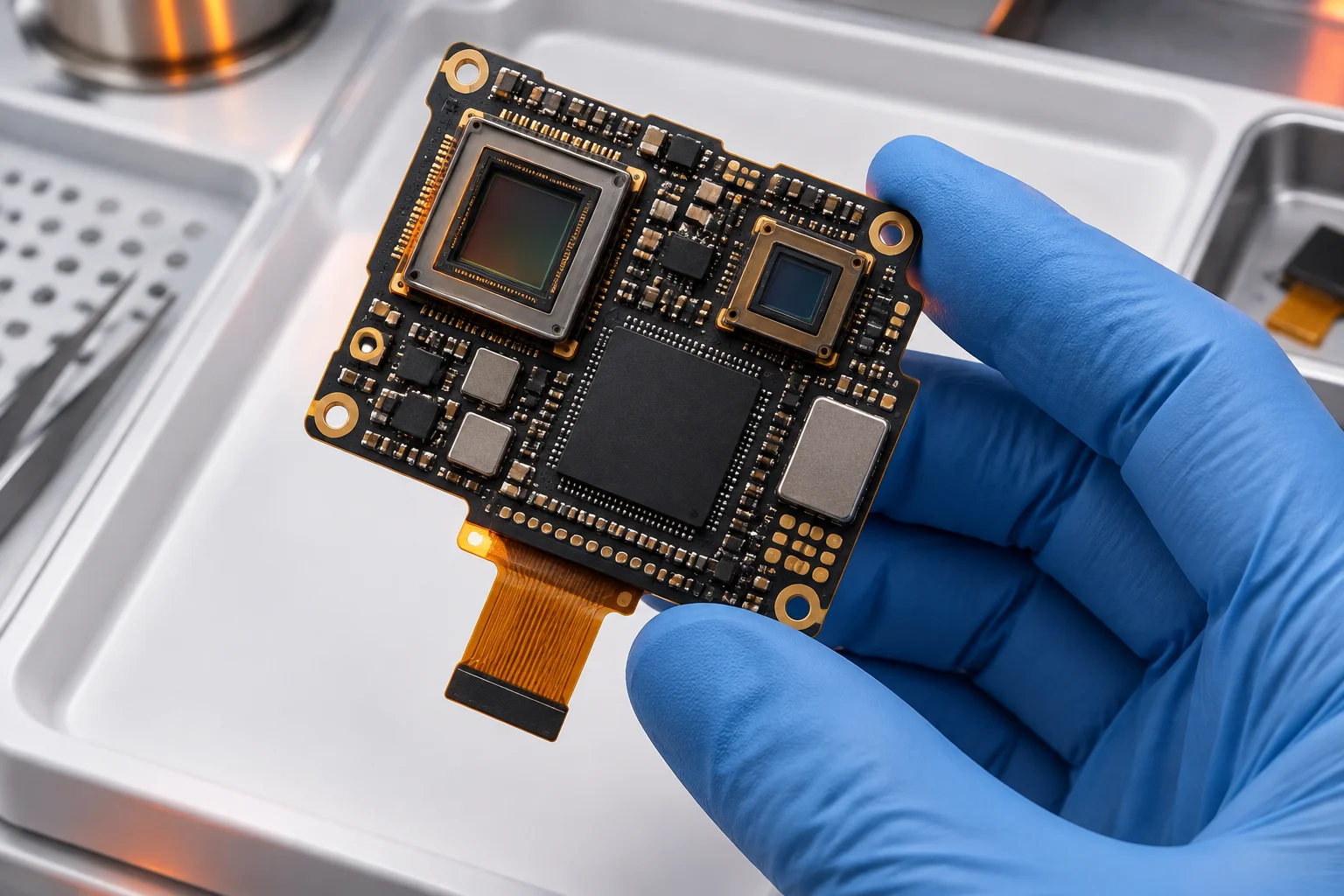
- G1Validated process gateReflow profile, wash recipe and coating program frozen per programme with a revision number. Rerun on any material or equipment change.Before lot 1
- G2Print and placement gate3D SPI on 100 % of boards with a CpK gate at 1.67 or better, then inline 3D AOI after reflow and again post-depanel.100 %
- G3Cleanliness gateIonic contamination measured per J-STD-001 against the 1.56 µg NaCl-eq/cm² limit on every washed lot.Every lot
- G4Non-conformance gateQuarantine with hold tag, material review disposition, customer notification in the agreed format where the programme requires it.Zero release
- G5Lot release gateQuality assurance signs the lot against the control plan before packing. No signature, no shipment — including on a schedule-critical order.Every lot
Documents and certifications you receive
The pack is produced alongside the build. Certificate numbers are never published; copies of every certificate below are released under NDA.
A device-history-style build record is issued per lot, keyed to the unit serial and covering the incoming material lots, the process parameters actually run, the inspection results at each gate and the release signature. The first-article report follows the AS9102 structure, because it is a stronger structure than most medical templates ask for and it carries X-ray, cross-section and dimensional data in one document.
Alongside those, every shipment carries a certificate of conformance, the cleanliness result, the coating record where a coat is applied, and material declarations for RoHS 2011/65/EU and REACH. Records are retained for 10 years. Any change to process, material or manufacturing site is notified in writing before it is implemented.
- Quality system
- ISO 13485:2016, ISO 9001:2015 base
- Environmental
- ISO 14001:2015
- Workmanship
- IPC-A-610 Class 3, J-STD-001
- Rework
- IPC-7711/7721
- Coating
- IPC-CC-830
- ESD programme
- ANSI/ESD S20.20-2021
- Substances
- RoHS 2011/65/EU, REACH SVHC below 0.1 %
- Retention
- 10 years
A Class III infusion-pump OEM, prototype to 2,000 units a month
Anonymised as required. No customer name, no product name, no part numbers — the constraints are the useful part.
The programme started as 20 engineering samples of a control board with two 0.35 mm pitch BGAs, a pressure sensor in a package that cannot be washed indefinitely, and a coating requirement that had to survive a cleaning cycle. The first packaging constraint was clear in DFM: the sensor had to be masked, which meant the wash process had to be validated around a masked part rather than the board as a whole.
First article ran on the dedicated NPI line with cross-sections on both BGAs, an ionic contamination result, and a reflow profile logged against the 1.5 °C repeatability window. The customer's quality team signed the first-article report, and the same package — profile revision, cleaning recipe, coating program — became the control plan for production.
The build then moved to 2,000 units a month on a volume line, with lot release by quality assurance, unit serialisation and a device-history-style record per lot. Repeat orders run 3 to 4 weeks ARO under the existing programme with no minimum order quantity, and the test fixture built for first article is owned by the customer.
A masked sensor inside an assembly that still has to pass a wash and an ionic test. The wash recipe was re-validated around the mask, and the cleanliness result is measured per lot rather than assumed from the process.
Questions medical buyers ask us
Yes. We host customer audits and source inspections by appointment, and the records an auditor will ask for — device-history-style build records, first-article reports, cleanliness results, calibration records and training records — are held for 10 years. Certificate copies for ISO 13485:2016, ISO 9001:2015 and ISO 14001:2015 are released under NDA, and we will walk an auditor through the routing for a specific serial rather than showing a generic process map.
We build the board and the sub-assembly; we do not sterilise and we do not seal the sterile barrier. What matters on our side is what we hand over: a washed, coated assembly with the ionic result recorded, packed in moisture-barrier material with a desiccant and a humidity indicator card, and a material declaration that names every coating and adhesive in contact with the packaging. That is the input your sterilisation validation needs.
We settle the material question in DFM, not after first article. Coatings are specified by class — acrylic, polyurethane or silicone to IPC-CC-830 — and every adhesive, coating and laminate in the build gets a RoHS 2011/65/EU and REACH declaration, with SVHC content held below 0.1 % w/w. Where an assembly touches a patient, we flag it during DFM so your own biocompatibility work starts from a frozen material list instead of a moving one.
Send the Gerber set, the BOM and your standard
Tell us the device class and the standard you are audited against. DFM review comes back in 24 hours, a firm quote in 48, and the cleanliness, coating and record requirements are priced in from the start.