Two plants, six SMT lines, 42,000 sq ft of controlled floor
San Jose runs the volume work, the NPI work and everything that needs an engineer within walking distance. Penang runs the second-source and Asia-ship programmes. Both sites share one process, one AOI recipe library and one quality system.
- San Jose floor
- 42,000 sq ft · 3,900 m²
- Penang floor
- 18,000 sq ft · 1,670 m²
- SMT lines
- 6 · 4 + 2
- People
- 210 · 150 + 60
- Combined placements
- 14 million per month
- ESD programme
- ANSI/ESD S20.20-2021
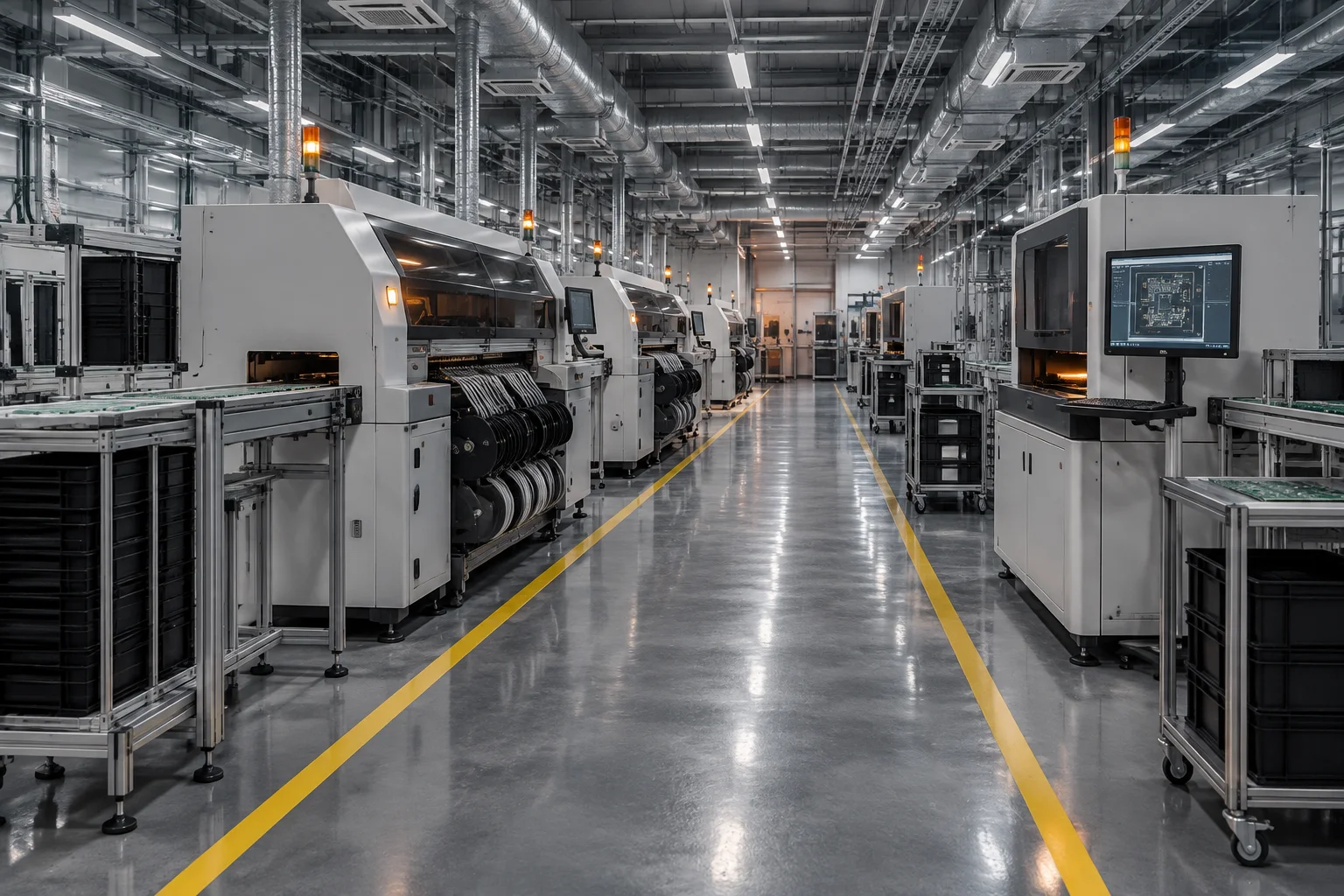
Four lines in San Jose, each set up for a different job
Line assignment is made at DFM sign-off and does not change mid-programme without telling you why.
Lines 1 and 2 are the volume lines: high-speed mounters running 01005 chips through to 55 mm connectors at 30,000 components per hour, feeding a 12-zone nitrogen reflow oven. They are set up for panels from 20 × 20 mm up to 610 × 510 mm and for runs measured in thousands of units.
Line 3 carries the mixed-technology load. It pairs SMT with two wave pots and three selective solder robots so a board with a press-fit connector, a transformer and a fine-pitch QFN can be finished without leaving the floor. Line 3 is also where pin-in-paste work runs when it can remove a wave step.
Line 4 is the NPI and flex line. It exists so that a 5-board prototype is not queued behind a 20,000-unit release, and so that engineering changes can be built the same week they are drawn. Stencils are laser cut in 4 hours from your Gerber, and the first article carries X-ray, cross-section and dimensional data before the programme is released. What changes at each volume stage is set out on prototype to production.
All four lines share the same AOI recipe library, the same reflow profile database and the same MES. A recipe proven on the NPI line transfers to a volume line without being rebuilt, which is why first-article data stays valid when a programme ramps.
The equipment list, with the parameter that matters for each
Machines are only interesting for what they hold. This is the number we watch on every one of them.
| Stage | What runs it | Parameter held |
|---|---|---|
| Stencil | Laser-cut stainless foil, nano-coated, cut in-house | 0.10–0.20 mm foil, 4-hour turn |
| Paste print | Solder paste printer with automatic stencil wipe | 3D SPI on 100 % of boards |
| Print verification | Inline 3D SPI measuring volume, area and height | CpK ≥ 1.67 gate |
| Placement | High-speed and flexible modular mounters | ±35 µm chip, ±25 µm fine pitch |
| Component range | Same nozzle set across the lines | 01005 to 55 mm connectors |
| Reflow | 12-zone convection oven, nitrogen inerted | ±1.5 °C profile repeatability |
| Wave solder | Two pots on the mixed-technology line | 0.6–6.4 mm hole fill |
| Selective solder | Three programmable selective solder robots | IPC-A-610 Class 2 / 3 |
| Optical inspection | Inline 3D AOI after print, reflow and depanel | 3 gates per board |
| X-ray | 2D plus 3D CT transmission systems | void ≤ 25 % per IPC-A-610 |
| Cleaning | Inline aqueous washer with ionic contamination test | ≤ 1.56 µg NaCl-eq/cm² |
| Coating | Automated selective conformal coating spray | IPC-CC-830 |
| Depanel | Router, laser, V-score and water-jet | 0.5 mm burrs removed |
| Traceability | Board-level serialisation written to MES | 10 years retention |
Penang, and how an order moves between the two sites
The Penang plant opened in 2019 inside the Bayan Lepas Free Industrial Zone, 18,000 sq ft with 60 people and two SMT lines. It was built for two jobs: giving customers a qualified second site inside Asia, and shortening the supply loop for programmes whose components are already kitted in the region.
Penang carries the same process definition as San Jose — the same printer settings, the same SPI thresholds at CpK ≥ 1.67, the same 12-zone nitrogen profile window at ±1.5 °C, the same three AOI gates and the same 25 % void limit on area-array packages. What differs is the mix: Penang runs a higher share of mature, high-volume part numbers and a lower share of first-article work.
A transfer between sites is a controlled event rather than a copy. The process engineer who qualified the assembly in San Jose writes the transfer package: AOI recipe, reflow profile, stencil specification, fixture drawings and the control plan. Penang builds a first article against it, the FAI report comes back to the originating engineer for sign-off, and the customer receives both sets of data. Tooling is duplicated rather than shipped, so both sites can run the programme in the same week.
Customers who need a single origin statement, a specific country of manufacture for tariff reasons, or a second site named on a PPAP submission get that written into the quality agreement at the start rather than discovered at shipment. The commercial mechanics of a transfer — who signs the first article, what ships when — follow the same sequence described under how an order runs.
San Jose: 42,000 sq ft, 150 people, four lines — three volume plus one NPI and flex. Penang: 18,000 sq ft, 60 people, two lines. Combined ceiling 45,000 units per month with 130 programmes running and 38 in NPI.
No programme moves to a second site without a fresh first article, a dimensional and X-ray report, and the originating engineer's signature. The customer is copied on all of it.
ESD and environment control on both floors
A board that passes AOI and then fails in the field is usually a handling problem, not a soldering problem. The controls below exist to close that gap, and the thresholds they protect are listed on the quality system page.
Static control
The whole programme is written to ANSI/ESD S20.20-2021 and audited internally. Wrist straps and heel grounders are tested at the start of every shift, workstations are bonded to a common ground, and ionisers sit on every line where insulators move through the process.
Floor and humidity
Conductive and dissipative flooring covers both assembly floors and the 12,000 sq ft ESD store. Relative humidity is logged and alarmed against the limits in the ESD control plan, because low humidity is what turns an ordinary tote into a charge generator.
Air and cleanliness
Filtered make-up air keeps particulates down across the print and reflow zones, and positive pressure is held in the coating and cleaning cells. Solvent, flux and coating vapours are extracted at the point of use rather than at the room level.
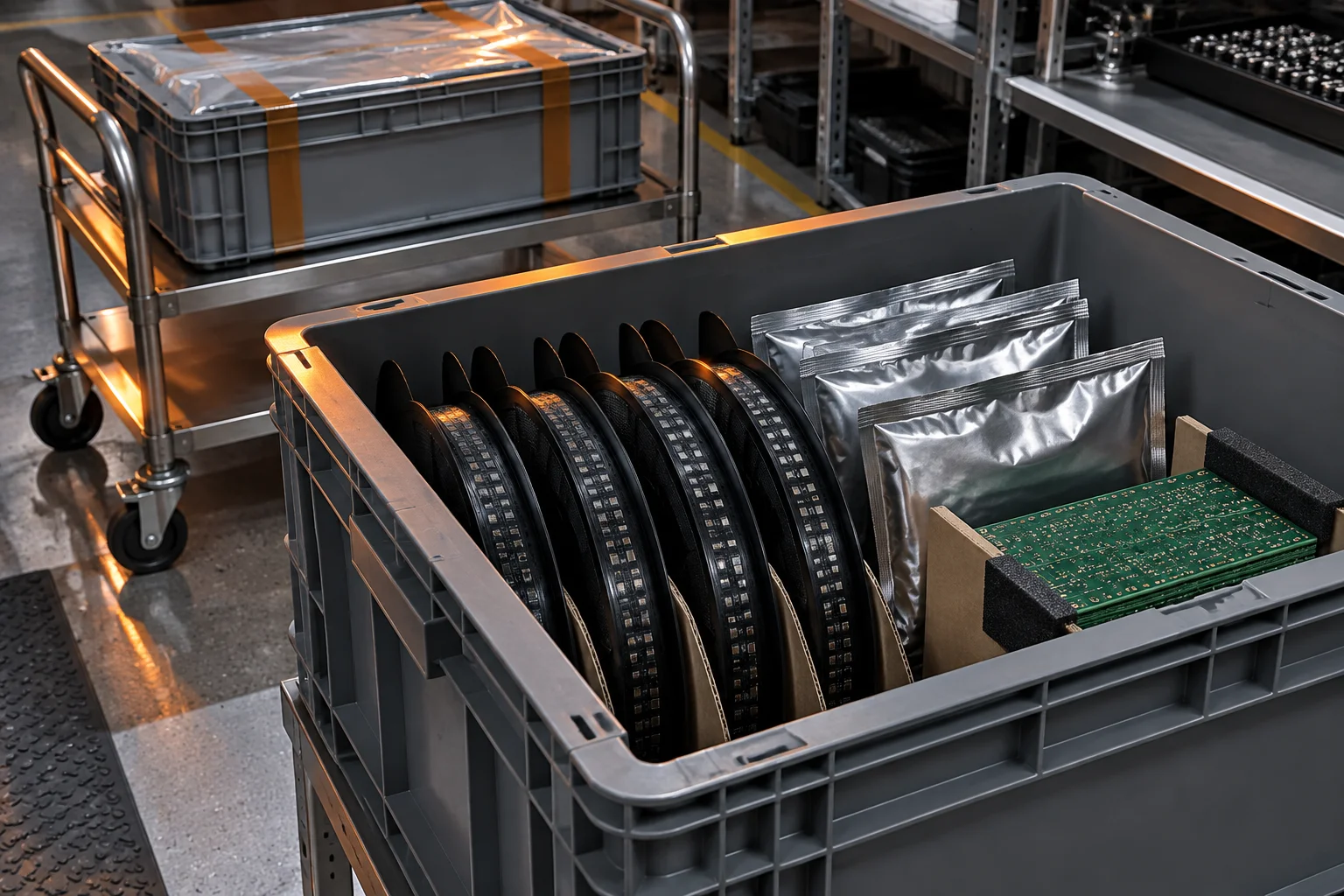
Kitting, moisture sensitivity and reel-level traceability
Every reel that enters a kit is linked to the serial numbers it ends up in.
The store holds 4,000 unique part numbers across 12,000 sq ft of ESD-controlled racking. Kits are built per programme and per work order, not per machine, so a partial build does not leave orphaned reels on the floor. Each tote carries the reels, the moisture-barrier bags still sealed where they should be, and the paperwork that matches them. The rules for buying, substituting and holding that stock are on the component sourcing page.
Parts with a moisture sensitivity level are baked and logged against J-STD-033 practice before they go to the printer, and the floor-life clock is tracked from the moment the bag is opened. When a bag is opened and not consumed, it is resealed with desiccant and a humidity indicator card, and the card is read at the next issue rather than assumed.
Traceability runs from the reel to the panel to the serialised assembly, and from the assembly back again if a customer raises a field return. The MES record holds the stencil, the SPI result, the AOI result, the X-ray image reference and the operator for every board, and it is retained for 10 years under an IPC-1782 style data model.
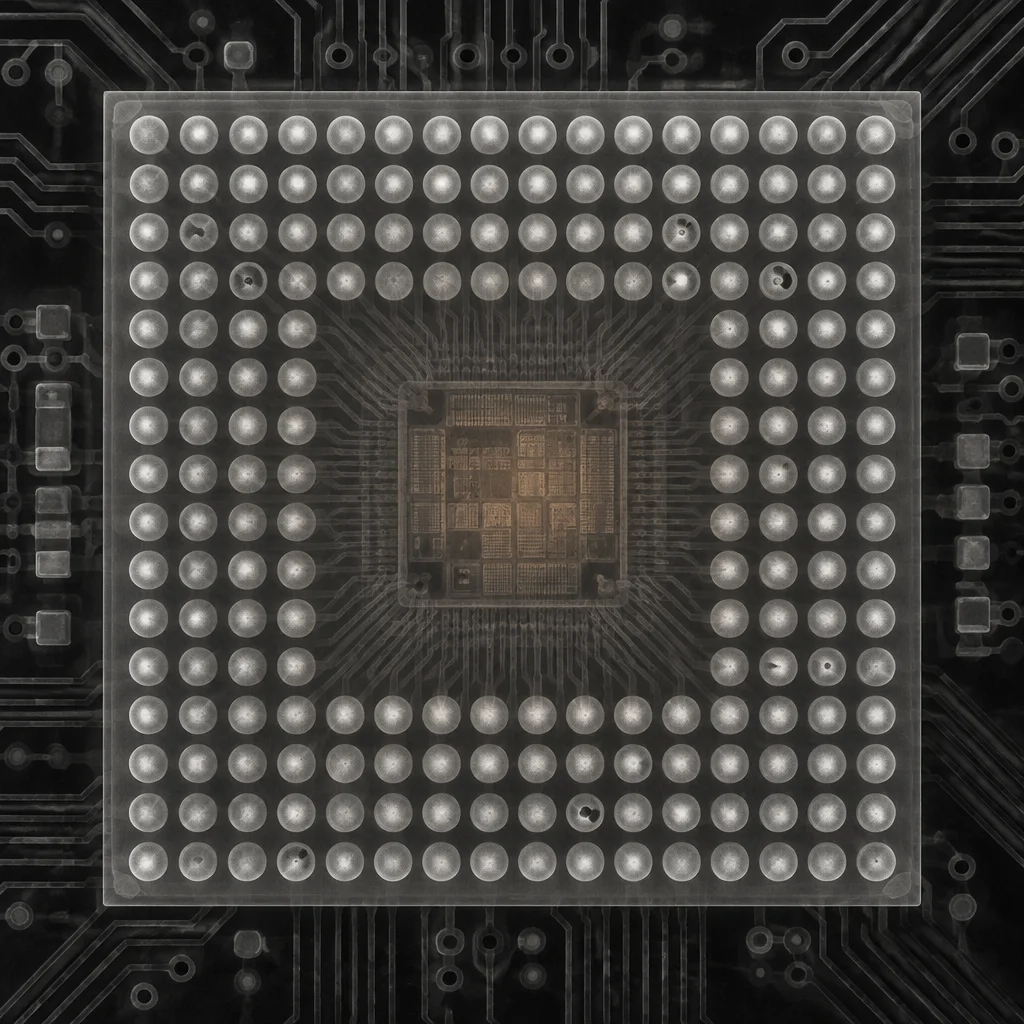
What the X-ray sees that AOI cannot
Optical inspection reads surfaces. The joints that fail on medical and automotive boards are underneath the package.
Every BGA, CSP and LGA goes through 2D and 3D CT X-ray. The 2D pass catches missing spheres, bridging and gross displacement in seconds; the 3D CT pass reconstructs the joint in slices so a void can be measured as a percentage of sphere volume rather than guessed from a shadow. The acceptance limit is 25 % voiding per IPC-A-610, applied per joint and per package.
The same system is what finds head-in-pillow, the defect that looks like a good joint from above and opens under thermal cycling. On a 0.35 mm pitch BGA there is no optical path to the joint at all, so X-ray is the only inspection that matters, and it runs on 100 % of the packages rather than on a sample.
When a joint sits outside the limit, the assembly is not reworked on a hunch. It goes to cross-section, the void is measured on the polished coupon, and the result decides whether the fix is a stencil aperture change, a profile change or a paste change. That measurement is what the FAI report cites.
Shifts, certification and who is allowed to touch your board
Both plants run three shifts, with 150 people in San Jose and 60 in Penang. The floor is deliberately stable: the operator who sets up your first article is usually the operator who runs the repeat order, because line assignment follows the programme rather than the shift roster.
Operators are certified to IPC-A-610 for the class they work on and to J-STD-001 for the process they run, and certification is renewed on the IPC cycle rather than extended by seniority. Rework and repair is a separate skill: only operators certified to IPC-7711/7721 are allowed to touch a joint after it has been inspected, and every rework is recorded against the serial number with the operator, the reason and the method.
Process engineers own the recipes: stencil specification, reflow profile, AOI thresholds, selective solder program and fixture design. A recipe change is a controlled document change with a reason code, a first-article confirmation where the change affects acceptance, and a note in the programme history that the customer can read.
Quality inspectors report outside the production line's reporting chain. When an inspector stops a panel at the SPI gate or rejects a package at X-ray, the decision is not re-opened by a production supervisor. It is either fixed or it is escalated, and the escalation path ends with the quality manager, not with the shipment date.
What we can build, and what we turn away
The ceiling is 45,000 board assemblies a month across the two plants, with 14 million placements behind it. That number is real capacity after changeover, maintenance and the NPI line's reserved time — not a peak figure measured in a good month. Repeat orders inside an existing programme are scheduled against it with no MOQ, while a brand-new high-volume programme competes for the same slots as everyone else's ramp.
Peak planning works from your forecast, not from a hunch. Programmes that send a rolling 12-month forecast get their line time reserved in advance; programmes that order month to month get what is left, and we will say so at quote rather than at shipment.
There are things we do not do, and it saves everyone time to say them early. We do not fabricate bare boards — we buy them from qualified fabricators and inspect them on receipt. We do not mould plastic enclosures; machining, powder coat and anodise are coordinated through qualified partners. We do not do wafer-level or die-level work, and we do not hold a Class 4 or MIL-PRF workmanship certification.
What we do hold is ISO 9001:2015, ISO 13485:2016, IATF 16949:2016, AS9100D and ISO 14001:2015 under one quality system, with ANSI/ESD S20.20-2021 for handling. Certificate copies and facility codes are released under NDA on request, and a customer audit can be arranged with two weeks of notice. The history behind the two plants and the people who run them is on the company page, and the full process window is broken down under capabilities.
Factory questions buyers ask before a visit
Yes. Customer audits, source inspection and witnessed first articles run across all 130 active programmes with two weeks of notice, so that the line you want to see is genuinely running your product rather than a demo build. Audit scope, checklist and the corrective-action response window are agreed in advance, and findings are answered in writing rather than in a closing meeting.
The quote names the site. San Jose carries NPI, mixed-technology and most North American volume; Penang carries mature high-volume part numbers and programmes that need an Asian origin. If a programme is going to be split across both, you are told at quote, and each site builds its own first article before production starts.
With a rolling 12-month forecast, yes. Reserved capacity is written into the programme schedule against the forecast quantity and reviewed each quarter. Without a forecast you are competing for whatever is uncommitted, and we will tell you at quote which weeks are already full rather than accept an order we cannot run.
Come and look at the floor before you place the order
Bring a board. We will walk the line it would run on, show you the SPI and AOI data from the last build of the same panel size, and tell you which of the six lines it would be assigned to.