From upload to shipment in six controlled steps
Every new package follows the same path: intake, DFM, first article, production, test and release, shipment. Nothing about it depends on how well we know you, and every step has a written output you can hold us to.
- DFM report
- 24 hours
- Firm quote
- 48 hours
- Prototype, standard parts
- 5–8 working days
- NPI pilot run
- 15 working days
- Production repeat
- 3–4 weeks ARO
- Stencil fabrication
- 4 hours
RFQ intake: send these files and nothing else is needed
A request that arrives complete is quoted in 48 hours. A request that arrives with three of the six items costs everybody a day.
What we need: Gerber data in RS-274X, an Excellon drill file, a netlist if you have one, a BOM that carries manufacturer part numbers and reference designators rather than descriptions, the quantity breaks you want priced, and the test requirement — no test, functional test, in-circuit or a specific customer specification. If you have an assembly drawing, a workmanship class call-out or a target date, send those too; they change the quote rather than decorate it.
If a file is missing, we do not guess. You get an email naming the file and what it blocks, usually the same working day. The two most common gaps are a BOM that lists commodity descriptions instead of manufacturer part numbers, and a Gerber set that has not been panelised or has no fiducials. Both are fixable within a day once somebody is told. Layout rules that prevent most of these are collected in the DFM design guides.
Gerber, drill, BOM and drawings go to the quote form or to the single sales address on this site. Anything ITAR-controlled should be flagged in the first line so it is routed to the registered process rather than the general inbox.
DFM and quote: an engineer reads it, then a price follows
The 24 hours is not a queue position. It is an engineer opening the Gerber against the BOM and the process window.
The DFM report covers panelisation and panel utilisation, fiducial and tooling-hole placement, land patterns against IPC-7351B density levels, stencil aperture limits at 0.10 mm to 0.20 mm foil, thermal relief on through-hole pads, component spacing against the nozzle and reflow envelope, and every BOM line that is obsolete, single-sourced or quoted beyond 16 weeks. Each item is marked as required or optional, with the measurement or the standard that drives it.
Alternates are proposed with a specific replacement and the qualification it needs — a drop-in cross-reference, a form-fit-function match, or a change that needs a new first article. The customer approves or rejects each one in writing, and the approved set becomes the controlled configuration for the programme.
The firm quote follows within 48 hours of a clean BOM and Gerber set, itemised by material, placement, test, tooling and any NRE. NRE is $0 on a standard single-sided SMT build. Fixture NRE is quoted separately and credited back at 5,000 units, so it does not hide inside the unit price. Common commercial questions — payment terms, tooling ownership, consigned stock — are answered on the procurement FAQ.
An unstacked drill file, an ambiguous surface finish, a BOM with no manufacturer part numbers, or a board outline that exists only in the mechanical drawing. Each one is a question we have to ask before we can price the build honestly.
NPI and first article: the build that decides the programme
The pilot run starts 15 working days after DFM sign-off. Everything a volume build will depend on is proven here.
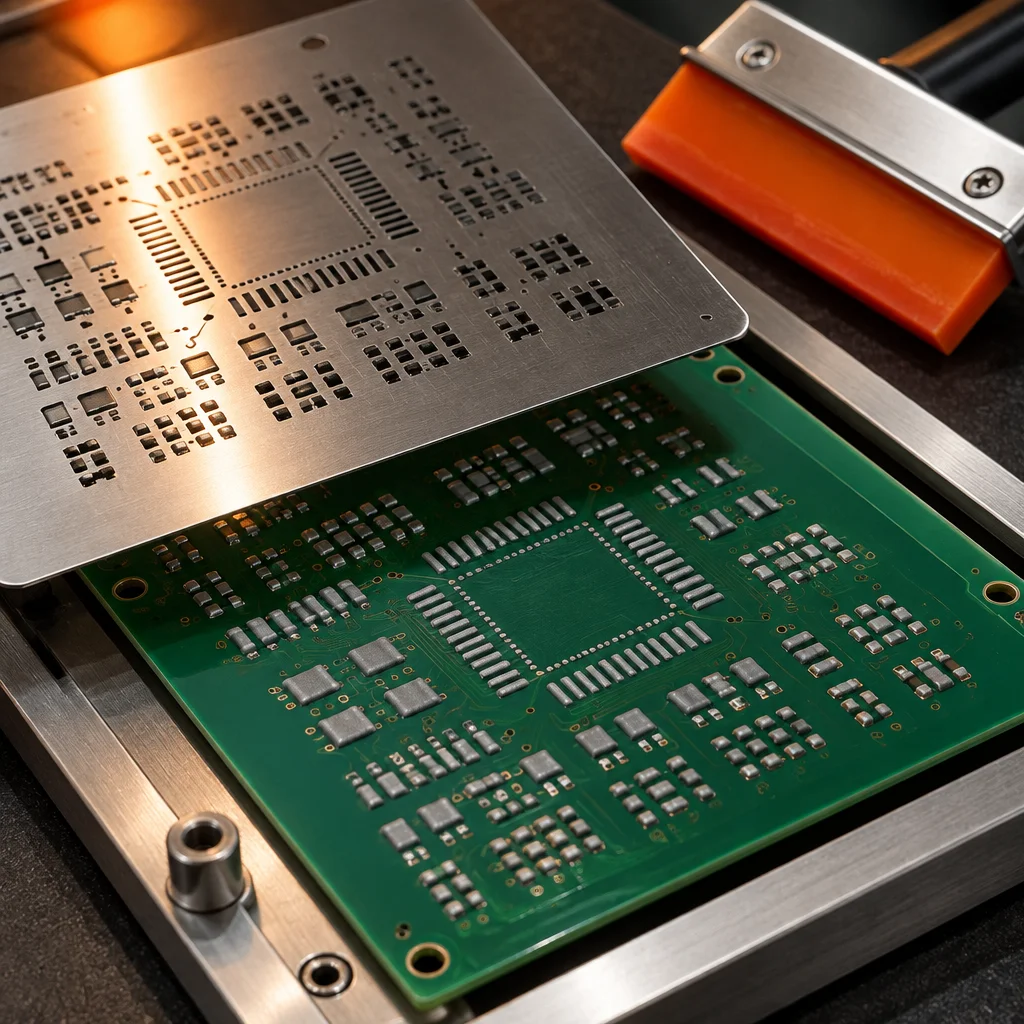
The stencil is laser cut in 4 hours from the approved Gerber, nano-coated and tensioned. Placement programs are generated from the centroid file and verified against the CAD data before the first panel is printed. The AOI recipe is built from the approved assembly drawing rather than from a good board, so the recipe can tell a correct joint from a wrong one rather than from an unusual one.
The first article carries an FAI report with X-ray images on every area-array package, a cross-section through the joints that carry the most risk, dimensional data on the connector and mechanical features, and the SPI and AOI results for the panel. A golden sample is retained and stored with the programme, and the customer signs the first article off before production is released.
Where a design has a known reliability question — a 0.35 mm pitch BGA under a shield can, a heavy copper bus, a connector that sees mechanical load — the first article is where we answer it, not the third production lot. The volume stages that follow the pilot are described on prototype to production.
The FAI report, the golden sample record and the frozen process configuration: stencil specification, reflow profile revision, AOI recipe revision and fixture revision.
Production: the same process, at a larger quantity
A released programme does not get re-engineered for volume. It gets more line time and the same gates.
Line assignment is made from the volume and the mix. High-volume single-design work goes to a volume line; mixed-technology work to the line with the wave pots and selective solder robots; small or changing quantities stay on the NPI and flex line so they are not queued behind a large release. The customer is told which line, and a change of line is communicated rather than silent.
In-process data accumulates per serial number as the board moves: the SPI result after print, the placement program and revision, the reflow profile used, the 3D AOI result after reflow, the X-ray result on area-array packages, and the post-depanel AOI result. MES records the operator at each station, and the retention period is 10 years.
Change control is the part customers care about most. A process change that could affect acceptance — a stencil revision, a profile change, a new component source, a fixture modification — is a controlled document change with a reason code, and where it affects acceptance it is confirmed with a first article before production continues under the change.
SPI, placement program revision, reflow profile, AOI results at three points, X-ray result, operator, component lots consumed, and the serial number that ties them together.
Test and release: what has to pass before it can be packed
Electrical test is defined at quote, not improvised at release. An assembly is only shipped against a test result that exists.
Flying probe suits low volumes and first articles, because it needs no fixture and can be changed in an afternoon. In-circuit test suits stable high-volume designs where the fixture cost is amortised. JTAG boundary scan suits boards with dense area-array packages and accessible scan chains, and functional test suits anything where behaviour under load matters more than continuity. Most programmes end up with two of the four.
Where the environment is the risk, burn-in and environmental stress screening run in chambers from 40 °C to 125 °C with HALT and HASS available through a partner network. Whatever the test, the pass and fail data is stored against the serial number for 10 years.
Release is a paperwork step as much as a technical one. The assembly leaves with a certificate of conformance against the specified IPC-A-610 class, packed in an ESD bag with desiccant and a humidity indicator card, and sealed to the packaging standard agreed for the programme — not to whatever bag is nearest the packing bench.
Certificate of conformance, test data reference, serial number list, and the packaging record. Label format, serialisation scheme and firmware revision where a box build is involved.
Ship and support: getting it there, and what happens after
Carrier, terms and the returns process are all decided before the first shipment rather than after the first problem.
Standard shipments go DDP or DAP depending on what your customs team prefers, with HS codes and country-of-origin statements issued by the site that built the boards. Packaging is specified for the route: moisture-barrier bags with desiccant for humid transit, foam-lined cartons for connectors that protrude, and edge protection for large panels.
The warranty is 12 months on workmanship against the IPC-A-610 class specified on the drawing. A return is raised through the single contact address on this site, gets an RMA number, and comes back to the same metrology bench that inspected it the first time. If the failure is ours, we rework or replace and close a CAPA against the cause. If it is not ours, you get the failure analysis data anyway, because a field failure you cannot explain is worse than one you can. Shipping and returns questions are handled by the same team listed under contact and locations.
Partial shipments are normal on ramps and are quoted as a schedule rather than as a single date. Each release carries its own certificate of conformance and its own serial number list, so a partial shipment never arrives without paperwork.
What slows an order down, and what it costs
Almost every schedule slip we see comes from one of five causes, and four of them are decided before production starts.
| Cause | Typical impact | How to avoid it |
|---|---|---|
| BOM without manufacturer part numbers | 1–2 working days | Send MPN, reference designator and quantity per board for every line |
| Unstacked or missing drill file | 1 working day | Export Excellon with all layers stacked and plated versus non-plated marked |
| Ambiguous surface finish or stack-up | 2–3 working days | State finish, copper weight and stack-up on the fabrication drawing |
| Course change after first article | 5 working days | Freeze the design at FAI sign-off; treat later changes as a new revision with a new first article |
| Component shortage found late | 1–3 weeks | Approve alternates at DFM sign-off rather than at kit issue |
Impacts are working days added to the committed date and reflect typical cases across current programmes, not a worst case. When a delay is ours, you hear about it before the ship date rather than on it.
Exactly what to attach, and in what format
Six items cover almost every build. Anything beyond that changes the quote rather than the schedule.
- Gerber data, RS-274X, one file per layer
- Excellon drill file, plated and non-plated stacked
- BOM with manufacturer part numbers and reference designators
- IPC-356 netlist where electrical test is required
- Assembly drawing with the workmanship class called out
- Test specification, plus coating, labelling and packaging requirements
Questions about the order process
Yes, and on a ramp it is usually the sensible option. Partial shipments are agreed as a schedule at quote rather than requested after the fact, and each release carries its own certificate of conformance, its own serial number list and its own packing record, so nothing arrives without paperwork that matches it.
Expedite fees are quoted rather than assumed. A 24-hour stencil turn is standard, and prototypes with standard parts run in 5–8 working days without any premium. Compressing a production repeat order below the 3–4 week ARO window means buying line time and material outside the plan, so it is priced as a separate line on the quote and only accepted when the material position actually supports it.
The change becomes a new revision with its own first article, even if only one layer moved. Panels already built to the previous revision are either finished and shipped as that revision or quarantined, and you decide which before we run the new revision. Cutting a design change in mid-lot without a new first article is how a programme ends up with two configurations in one shipment, and we will not do it.
Start with step one — send the package
Gerber, drill, BOM and test requirement. You will have a written DFM report inside 24 hours and a firm, itemised quote inside 48, with the alternates and lead times spelled out.