Component sourcing with the paperwork to survive an audit
Every line on your BOM is bought from an authorised or franchised distributor, inspected on receipt, and traced from reel to board serial number. Broker stock is refused rather than re-labelled, and the record is kept for 10 years.
- On-shelf inventory
- 4,000 unique MPNs
- ESD-controlled store
- 12,000 sq ft
- Sourcing channel
- Authorised / franchised only
- Longest lead time seen
- 26 weeks
Turnkey, consigned or hybrid — where the risk actually sits
The commercial model decides who owns the money, the schedule and the liability for a bad reel. Programmes usually start hybrid, then move to turnkey once the BOM stops changing.
| Model | What we hold | Risk carried | Fits |
|---|---|---|---|
| Turnkey | Purchase order, receiving inspection, kitting, MSL baking, traceability record | Price movement, allocation and schedule risk sit with us | BOM frozen, 500 pcs and above |
| Consigned | Receiving, count verification, storage, MSL control, build record | Quantity shortfalls and part quality stay with the customer | Customer-owned or customer-negotiated stock |
| Hybrid | Turnkey for commodity lines, consigned for the long-lead or customer-specified devices | Risk is split line by line and printed on the quote | NPI and pilot runs before a BOM freeze |
| Bonded stock | Segregated inventory reserved against your programme, released only to your work orders | Carrying cost is agreed in writing; material stays visible on a monthly reconciliation | Programmes with annual demand above 5,000 units |
How a BOM is priced before anything is bought
A quote is only as good as the BOM behind it. Five checks run before a number leaves the building, and each one can stop the quote.
-
Check 01 · same day
Scrub and normalise
Manufacturer part numbers are normalised, distributor suffixes and packaging codes are stripped, and every line is checked for manufacturer, package, tolerance and temperature grade. A 480-line industrial BOM normally returns 12 to 30 queries back to the design owner before pricing starts.
-
Check 02 · plus 4 hours
Lifecycle and PCN history
Each part is resolved to active, not recommended for new designs, or end of life, and the product change notice history is pulled. Lines with less than 24 months of published availability are flagged in the quote, not after the order.
-
Check 03 · plus 1 day
Alternates and cross-references
Where a line is single-sourced or extended, we propose form, fit and function alternates and state the parameter that actually differs — ESR, dielectric, tolerance, thermal resistance or pin-out. No alternate is bought without written approval from your engineering owner.
-
Check 04 · with the quote
RoHS and REACH validation
Declarations are collected per manufacturer part number against RoHS 2011/65/EU and its amendment (EU) 2015/863, and each homogeneous material is screened for REACH SVHC above 0.1 % w/w. Exemption claims such as lead in high-melting-point solder are recorded as exemption numbers on the build record.
-
Check 05 · with the quote
MOQ, packaging and reel breaks
Price is quoted at your quantity break and at the manufacturer minimum order quantity, so you can see the step. We state whether each line ships as a full reel, a partial reel or cut tape, because a 0402 chip bought as cut tape carries a different placement risk than one on a 5,000-piece reel.
Controls that keep suspect parts off the line
Counterfeit mitigation is a sourcing decision first and an inspection decision second. If a part never enters the building from an unverified channel, no test has to catch it later.
- C1 Source restrictionAuthorised or franchised distribution only. No independent brokers, no excess-lot purchases, no unverified marketplace sellers — including when the part is on a 26-week lead time and the customer asks for a shortcut. 100 % of lines
- C2 Receiving inspectionPackaging, reel labelling, date code, quantity and manufacturer markings are checked against the packing list under ANSI/ESD S20.20-2021 handling rules before the material is booked into the store. Every lot
- C3 Trigger testsX-ray fluorescence on finish and plating, solvent testing on marking permanence, and decapsulation with die verification when a lot's history, price or packaging does not match the authorised channel. Handling follows AS6081 practice. On trigger
- C4 Quarantine and notificationSuspect material goes into a locked cage with a hold tag, is never mixed with released stock, and the customer is notified in writing before anyone proposes a substitute part. Hold tag
Stopping a disappearing part from stopping your line
An end-of-life notice is a schedule problem, not a purchasing problem. The maths has to be done while there is still stock on a distributor shelf.
A last-time-buy is sized from annual usage multiplied by the remaining platform life, then corrected for storage life, moisture sensitivity level and the cost of carrying the material. A 20-year industrial platform with 800 units a year is a different decision from a consumer build with an 18-month life, even for the same device.
We subscribe to manufacturer product change notices and forward any notice affecting your BOM within 5 working days, with a recommendation: buy the bridge quantity, qualify an alternate now, or start a design change. Cross-references are only switched in after your engineering owner signs the approval, and any change to a critical parameter triggers a first article on the next build.
Where a customer wants protection but not ownership, we can hold a bonded buffer of agreed long-lead lines and report the balance every month.
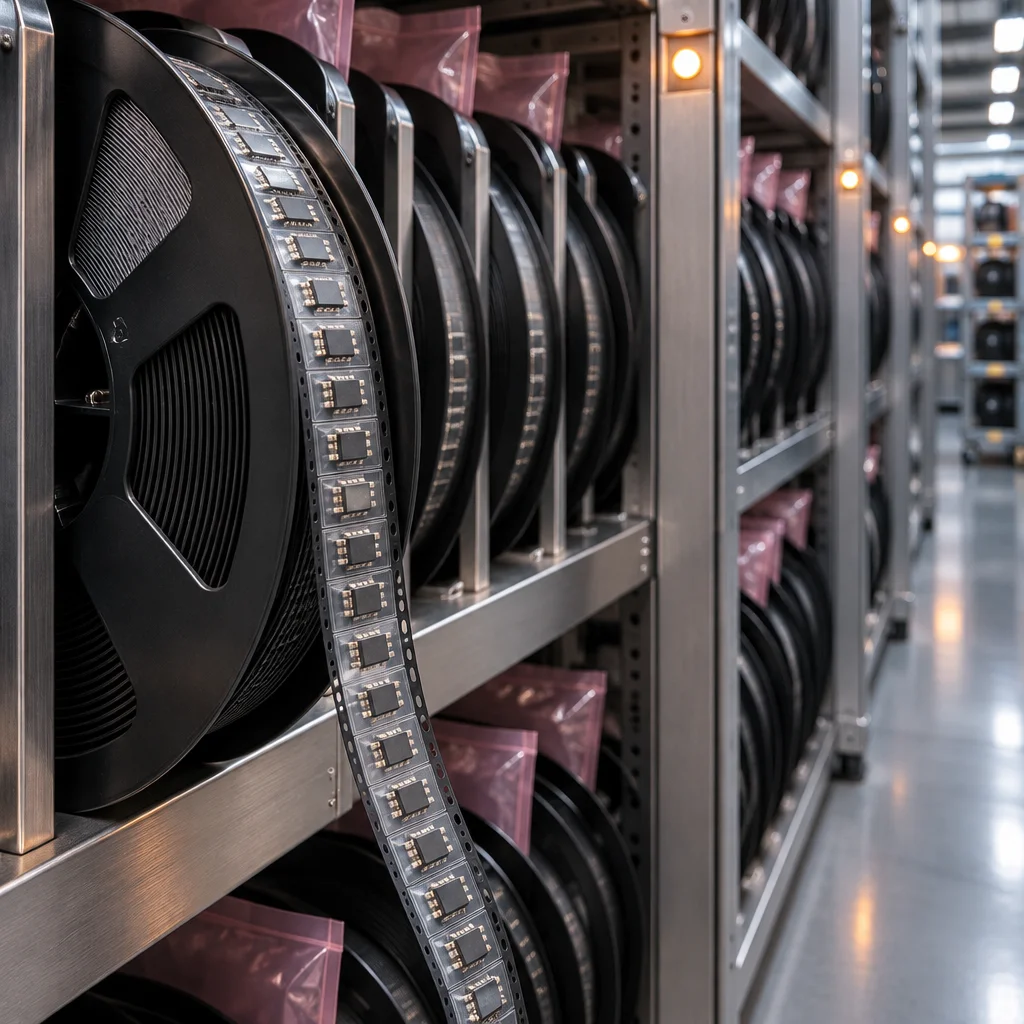
Moisture, static and time: the three ways stored parts go bad
Components sit in a 12,000 sq ft ESD-controlled store until a work order calls them. What happens in that store decides whether the reflow profile you validated still works.
Every reel is booked in against a work order and stays linked to the board serial numbers it ends up on. Scanning happens at receiving, at kitting and at the line, so a finished assembly can be traced back to the reel, the lot and the date code — the data is retained for 10 years in the IPC-1782 style record set.
Moisture-sensitive devices are handled on a logged clock. Dry-pack bags are opened in the kitting room, the exposure time is recorded, and parts that exceed their floor life are baked at 125 °C for 24 hours before reflow. Parts that go back to the shelf are resealed in a moisture-barrier bag with desiccant and a humidity indicator card.
Static control is continuous rather than procedural: wrist straps and ionisers at every bench, conductive tote bins in the store, and a documented audit under ANSI/ESD S20.20-2021. Floor and bench measurements are logged rather than assumed.
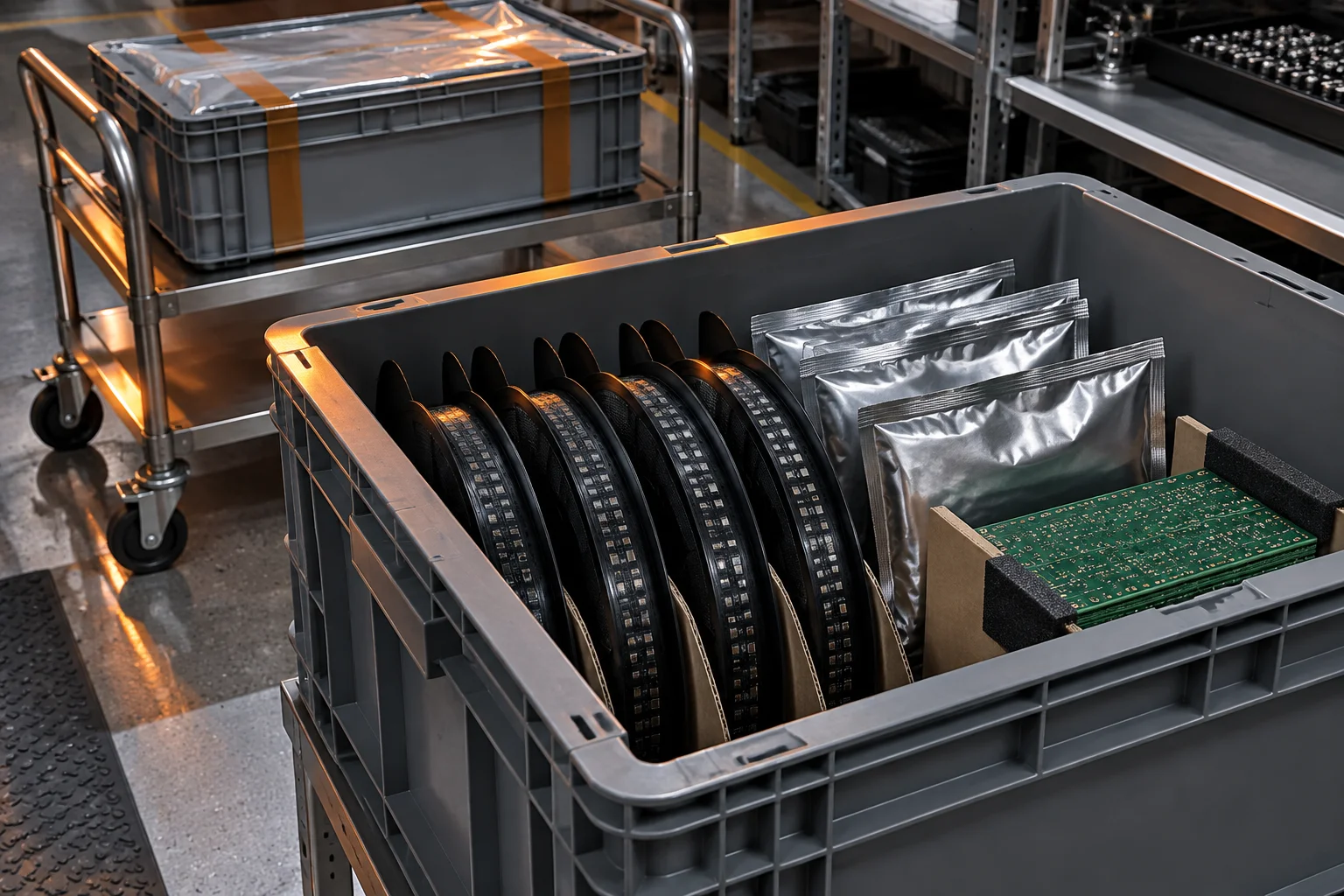
What ships with the parts and the boards
Sourcing documentation is the part auditors ask for. It is produced as a standard pack on every order, not assembled on request.
- Certificate of conformance per shipment, signed and dated
- RoHS 2011/65/EU and (EU) 2015/863 declaration per manufacturer part number
- REACH SVHC statement with any content above 0.1 % w/w declared
- Conflict minerals position under OECD due diligence and SEC 13p-1
- Counterfeit avoidance statement describing the authorised-channel policy
- Material lot, date code and reel traceability report on request
A 480-line BOM that arrived with a 26-week lead time
An industrial controller OEM came to us with a transfer programme and two power devices quoted at 26 weeks, against a build date 9 weeks out.
The DFM review, returned in 24 hours, flagged 14 lines: two devices on 26-week lead time, four lines not recommended for new designs, and eight lines with no second source. We quoted in 48 hours against the original BOM and, in the same document, against a version with a same-footprint MOSFET alternate and a bridge quantity on the two constrained lines.
The customer approved the alternate on day 3 after re-checking gate charge and thermal resistance. Production started on a partial kit for the first 300 pcs while the bridge quantity landed, and the full 2,000-piece build ran on one kit with no line stop. Every substitution is listed on the build record with the approval reference, which is exactly what a customer audit asks to see.
We will not buy a constrained part from a broker to protect a date. If the only material available is outside the authorised channel, the honest options are a qualified alternate, a bridge quantity, a partial shipment against a revised schedule, or a delay. All four get quoted.
Sourcing questions buyers ask before the first order
Yes. Consigned material is counted at receiving, checked for packaging and date code, and stored in the same ESD-controlled area as our own stock. If a dry-pack bag arrives already opened or the exposure clock cannot be established, the parts are baked at 125 °C for 24 hours before use and the bake is logged on the build record. Shortages are reported before the build starts rather than during kitting.
On turnkey orders you own what you paid for. Reel breaks and manufacturer minimum order quantities are visible on the quote, and the balance is either shipped with the boards, held as bonded stock against your next order, or scrapped at your instruction. Consigned material stays yours throughout, including anything left on a partial reel.
We hold bonded inventory under a written agreement that names the part numbers, quantities and release rules. The material is physically segregated, released only against your work orders, and reconciled monthly. For platforms with a 15-year or 20-year service life we will model the last-time-buy with you and review it once a year as demand moves.
Send the BOM. Get risk, alternates and price back in 48 hours.
Attach the BOM with manufacturer part numbers and your Gerber set. We return a scrubbed BOM, lifecycle flags, proposed alternates and a firm quote — plus the sourcing model that puts the risk in the right place.